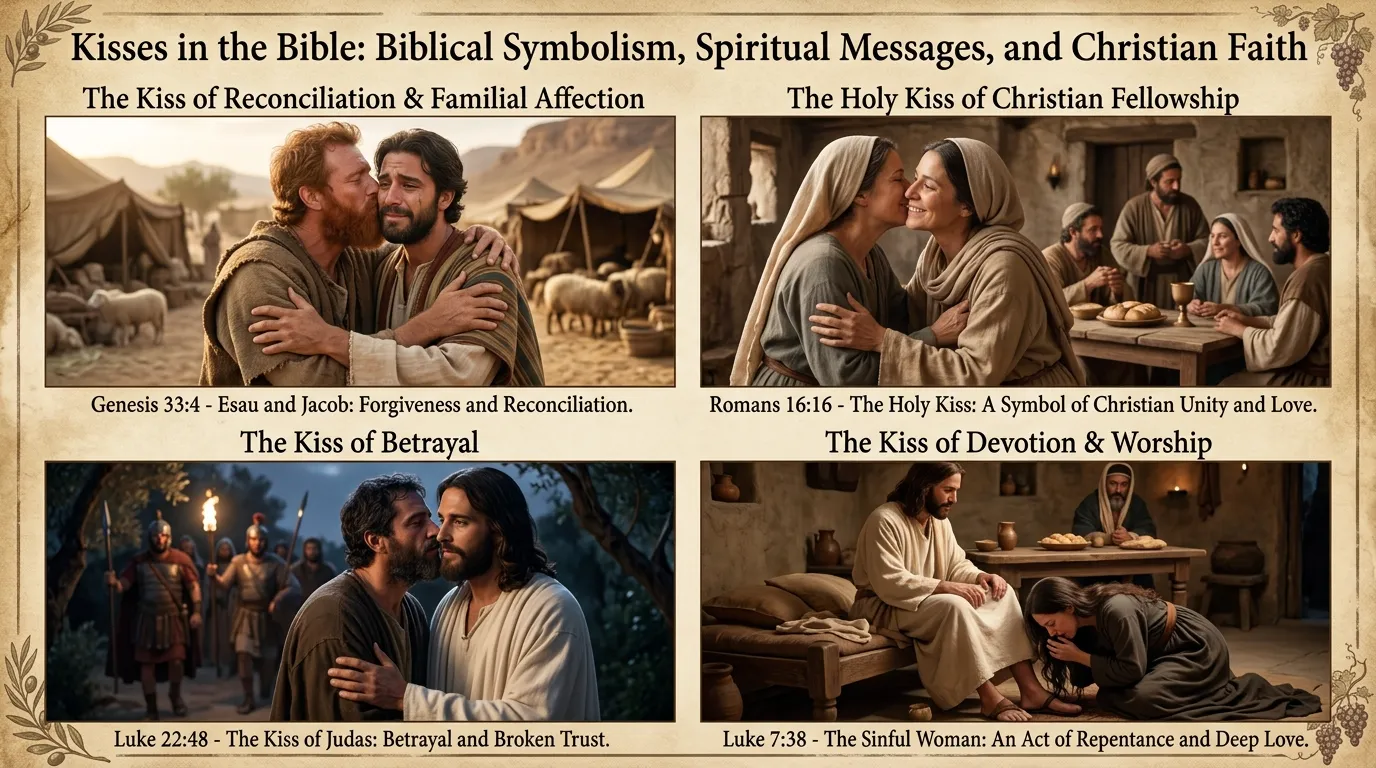
In the last week of His life, Jesus received two kisses. The first came in the house of a Pharisee, from a woman with a ruined reputation who wept over His feet, wiped them with her hair, and “kissed his feet” again and again (Luke 7:38, 45). Jesus called it love — the overflowing gratitude of a forgiven heart. The second came in a garden at midnight, from one of His own twelve: “the one who would betray him gave them a sign, saying, ‘The one I will kiss is the man; seize him.’ And he came up to Jesus at once and said, ‘Greetings, Rabbi!’ And he kissed him” (Matthew 26:48-49). Jesus called it what it was: “Judas, would you betray the Son of Man with a kiss?” (Luke 22:48).
Same gesture. Opposite hearts. That is the Bible’s whole teaching on kisses in a single contrast: a kiss is a signature — it reveals the heart of the one who gives it. Across Scripture, kisses sign documents of blessing, reconciliation, worship, fellowship — and forgery. To read them rightly is to learn to read hearts, beginning with your own.
The Kiss of Blessing
In the world of the patriarchs, a kiss was how blessing was delivered. When old, blind Isaac prepared to bless his son, the ritual began with touch: “Come near and kiss me, my son” (Genesis 27:26). The kiss drew Jacob close enough for his father to smell his garments and speak the words that would shape nations. It was intimate on purpose — blessing in Scripture is never a form letter; it is personal, breathed from one life into another.
The most moving kiss of blessing in the Bible comes from a father who had stopped expecting his son to come home. The prodigal, rehearsing his apology speech, was still “a long way off” when his father saw him — and “felt compassion, and ran and embraced him and kissed him” (Luke 15:20). The kiss came before the confession. Before the “I have sinned.” Before any evidence of change. That is the order of grace: the Father’s kiss does not reward repentance; it welcomes it. Every believer who has come home to God has been met the same way — embraced mid-sentence, kissed before the apology was finished.
The Kiss of Reconciliation
Some of Scripture’s kisses seal the end of wars between brothers. Jacob, returning home terrified of the brother he had cheated twenty years earlier, sent gifts ahead, divided his camp, and braced for revenge. Instead, “Esau ran to meet him and embraced him and fell on his neck and kissed him, and they wept” (Genesis 33:4). Twenty years of grievance dissolved in a single embrace. The kiss did what the gifts could not: it said we are brothers again.
Joseph’s story ends the same way. After revealing himself to the brothers who sold him, “he kissed all his brothers and wept upon them” (Genesis 45:15) — and only afterward did they dare to talk with him. The kiss came first; the conversation followed. Reconciliation in the Bible is not a negotiated settlement; it is an embrace that makes negotiation possible. If you are waiting to feel reconciled before you move toward someone, you have the order backward. The kiss — the act of grace — comes first.
The Kiss of Worship
Psalm 2 — the Bible’s great coronation psalm — ends with an astonishing command to the rebellious kings of the earth: “Kiss the Son, lest he be angry, and you perish in the way” (Psalm 2:12). In the ancient world, kissing the hand or the feet of a king was the gesture of submission — the vassal’s pledge of loyalty. The psalm takes that court etiquette and aims it at God’s Anointed: worship is allegiance expressed with the lips. To “kiss the Son” is to surrender — to lay down rebellion and take up loyalty.
That is exactly what the woman in the Pharisee’s house was doing, though Simon the host could not see it. Her kisses on Jesus’ feet were not sentimentality; they were submission — the homage of a subject to her King, paid in tears. Jesus defended her against the sneering host: “her sins, which are many, are forgiven — for she loved much” (Luke 7:47). The kiss of worship is the kiss of the forgiven: it says You are Lord, and I am Yours with more eloquence than any hymn.
The Kiss That Lied
But Scripture will not let us sentimentalize the kiss, because it also records the forgeries. Judas chose a kiss as the betrayal signal precisely because it was the gesture of a disciple — greeting a rabbi with a kiss was normal, warm, expected. That was the horror of it: the most intimate gesture became the instrument of the most intimate treachery. Evil rarely arrives wearing a snarl; it arrives wearing a smile, and sometimes it kisses you first.
Judas was not the first. Years earlier, Joab — David’s commander — greeted his rival Amasa with “Is it well with you, my brother?”, took him by the beard “to kiss him” — and drove a sword into his belly (2 Samuel 20:9-10). The pattern is identical: affection as camouflage, closeness as a weapon. Which is why the Bible gives the proverb as a guardrail: “Faithful are the wounds of a friend; profuse are the kisses of an enemy” (Proverbs 27:6). A true friend may hurt you with honesty; a false one will soothe you with flattery. Learn to distrust the kiss that costs the giver nothing and profits him much.
The spiritual lesson is discernment. Not every warm gesture is holy, not every “brother” is a brother, and not every spiritual compliment is safe. Jesus loved Judas to the end — He washed his feet, He called him “friend” even in the garden (Matthew 26:50) — but He was never fooled by him. Love without discernment is naivety; discernment without love is cynicism. Christ held both.
The Kiss of Fellowship
Then there is the kiss the New Testament commands. Five times the apostles instruct the churches: “Greet one another with a holy kiss” (Romans 16:16; 1 Corinthians 16:20; 2 Corinthians 13:12; 1 Thessalonians 5:26; 1 Peter 5:14). In a culture where a kiss was the standard greeting between family members, the early church took the family gesture and extended it to the whole family of God — Jew and Gentile, slave and free, rich and poor.
Think about what that meant. In the ancient world, you did not kiss social inferiors. But in the church, the holy kiss declared that the gospel had created a new kinship deeper than blood and stronger than class. It was holy — set apart from romantic or manipulative use — precisely because it was fraternal: the embrace of brothers and sisters who shared one Father. The church eventually replaced it with handshakes and embraces for practical reasons, but the meaning stands: Christians are family, and family greets with warmth, not cold formality.
There is a challenge here for the modern church. Many congregations are friendly to friends and frosty to strangers — the exact opposite of the holy kiss. The apostolic command pushes the other way: greet one another — the whole “one another,” not just the ones you know. Warmth toward the unfamiliar is not extroversion; it is obedience.
Reading the Kisses — Including Your Own
So what do kisses mean in the Bible? They mean what the heart means. A kiss is magnifying: it takes whatever is inside — love or treachery, worship or manipulation — and makes it visible. That is why Scripture lingers over them. The Father’s kiss exposes grace. Esau’s kiss exposes forgiveness. The woman’s kisses expose worship. Judas’s kiss exposes the most chilling truth of all: that the human heart can press its lips to Christ while selling Him for silver.
Which raises the question Scripture always finally asks: what does your kiss say? Is your affection for Christ the costly, tearful kind — or the convenient, garden-at-midnight kind? Do your greetings build fellowship or manage appearances? The Bible does not ask us to stop kissing, literally or figuratively. It asks us to mean it — to let the gesture match the heart, and to let the heart be captured by the One who is worthy of every kiss of worship we have. For the long cultural history of the kiss as greeting, blessing, and symbol across civilizations, Wikipedia’s article on the kiss makes illuminating reading alongside these biblical portraits.










