Moses — who had watched a generation die in the wilderness — prayed a strange prayer: “Teach us to number our days that we may get a heart of wisdom” (Psalm 90:12). He did not ask God to teach him to avoid death, or to ignore it, but to number his days — to count them, face them, learn from them. The Bible treats death the way Moses did: not as an obscenity to be hidden, but as a teacher to be heard. Every death in Scripture is a classroom. Here is what the great ones teach.
A word before we begin, for the grieving heart that may be reading: the Bible never mocks your tears. It honors them. Jesus wept at a grave (John 11:35). God collects tears in His bottle (Psalm 56:8). The lessons below are not meant to hurry your grief but to hold it — to show that Scripture has walked this road before you, and that the road does not end in the dark.
Abel: The Blood That Still Speaks
The first death in the Bible is also the first murder. Cain killed Abel, and God said something unforgettable: “The voice of your brother’s blood is crying to me from the ground” (Genesis 4:10). Abel never preached a sermon. He never wrote a psalm. Yet the New Testament says that “through his faith… he still speaks” (Hebrews 11:4) — and that his blood “speaks a better word than the blood of Abel” belongs to Christ (Hebrews 12:24).
What does Abel teach? That a righteous life cannot be silenced by violence. Cain silenced the brother; he could not silence the testimony. This is the Bible’s first answer to every grave dug by injustice: the story is not over when the murderer walks away. God hears blood crying from the ground. For those who grieve victims of violence, this is not abstract theology — it is the bedrock promise that no death escapes God’s notice, and no injustice gets the last word.
Moses: The Grave God Dug Himself
Moses died alone on Mount Nebo, within sight of the land he would never enter. And then Scripture records one of its most tender details: “he buried him in the valley in the land of Moab… but no one knows the place of his burial to this day” (Deuteronomy 34:6). He buried him — God Himself. The only funeral in the Bible where God is the undertaker.
Why does this matter? Because Moses’ death was, by human measure, a failure — the great leader kept out of the promise for one angry moment at the rock (Numbers 20:12). Yet God did not abandon him at the end. He personally laid him to rest. The lesson: your failures do not forfeit God’s tenderness. The same God who disciplined Moses carried his body to its grave. For every believer who fears they have disappointed God beyond repair, Moses’ burial preaches that grace outlasts even our worst moments — God’s love does not expire when our record does.
There is a second lesson in the hidden grave. God buried Moses secretly — and Jude tells us Michael contended with the devil over his body (Jude 9). Why the secrecy? Almost certainly to prevent the very thing Israel would have done: turn the tomb into a shrine, the prophet into an idol. God hides what we would worship. Even the greatest servants must not become objects of devotion. The grave is hidden so that the glory stays where it belongs.
Lazarus: Jesus Wept First
When Jesus arrived at Bethany, Lazarus had been dead four days. Mary fell at His feet with the words every grieving heart has spoken: “Lord, if you had been here, my brother would not have died” (John 11:32). Jesus knew He was about to raise Lazarus. He knew the tomb would be empty within the hour. And yet — “Jesus wept” (11:35). The shortest verse in the Bible, and one of the deepest.
Why would omnipotence weep at a grave it was about to open? Because grief is not unbelief. Jesus did not rebuke the tears; He joined them. He wept though He knew the resurrection was minutes away — which means tears are not a failure of faith but a feature of love. Anyone who tells you that strong Christians don’t cry has not read the Gospels. The Son of God stood at a grave and wept, knowing exactly how the story ended.
And then He did what only He can do: “Lazarus, come out” (11:43) — and the dead man walked out, still wrapped in grave clothes. The lesson for every funeral: death is real, grief is holy, and neither is final. The One who wept at the grave is the One who empties graves. Hold both truths at once; Scripture does.
Stephen: Dying Like His Lord
The first Christian martyr died the way his Master did — praying for his killers. As the stones fell, Stephen cried out “with a loud voice, ‘Lord, do not hold this sin against them.’ And when he had said this, he fell asleep” (Acts 7:60). Fell asleep — Scripture’s gentle word for the death of believers (see also 1 Thessalonians 4:13-14). Not annihilation. Sleep. The expectation of waking.
Two lessons rise from the stones. First, grace can make a dying person forgiving. Stephen’s prayer echoes Christ’s “Father, forgive them” (Luke 23:34) — proof that the Spirit can reproduce the character of Jesus even in a hail of rocks. Death does not have to make us bitter; in Christ, it can make us like Christ.
Second, a faithful death plants seeds. Standing in the crowd, guarding the cloaks of the killers, was a young Pharisee named Saul (Acts 7:58; 8:1). He approved of the execution. He could not have known that the dying man’s face — “like the face of an angel” (6:15) — and his forgiving prayer would haunt him all the way to the Damascus road. God wastes no faithful death. The blood of the martyrs, Tertullian said, is the seed of the church — and the first seed was Stephen’s, falling into the soil of Saul’s conscience.
Paul: The Departure as an Offering
Years later, in a Roman prison, the old apostle wrote his own epitaph: “For I am already being poured out as a drink offering, and the time of my departure has come. I have fought the good fight, I have finished the race, I have kept the faith” (2 Timothy 4:6-7). Three images in two verses: a sacrifice (poured out), a journey (departure — the word for loosening a ship from its moorings), and a race (finished, not abandoned).
Paul teaches us how to think about our own dying. Not as defeat — “to die is gain” (Philippians 1:21). Not as disappearance — “to depart and be with Christ… is far better” (1:23). But as completion: a fight fought, a course finished, a faith kept. The Christian does not merely stop living; he arrives. And the arrival is certain, because it rests not on the perfection of the race but on “the crown of righteousness, which the Lord, the righteous judge, will award” (2 Timothy 4:8) — awarded, not earned; given by the Judge who is also the Savior.
The Death That Defeated Death
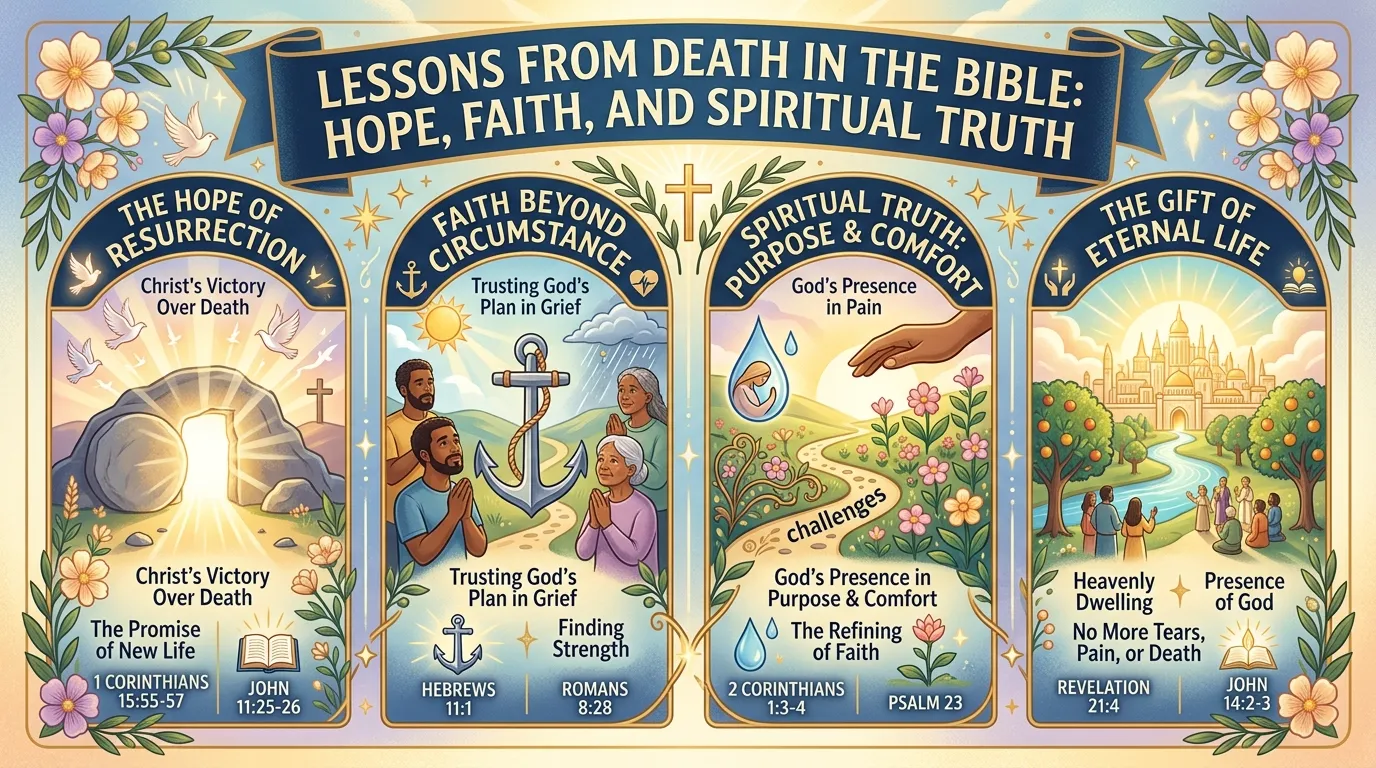
All these lessons gather at one tomb — the empty one. “Death is swallowed up in victory. O death, where is your victory? O death, where is your sting?” (1 Corinthians 15:54-55). The resurrection of Jesus does not remove death from human experience; it removes death’s finality from the believer’s future. “He will wipe away every tear from their eyes, and death shall be no more” (Revelation 21:4).
So here is the Bible’s full curriculum on death, taught by Abel, Moses, Lazarus, Stephen, and Paul: death is real but not ultimate; grief is holy but not hopeless; dying can be faithful; and the grave is a doorway, not a destination. Number your days, as Moses prayed — not to live in fear of the last one, but to live every one before it with the wisdom of those who know where the road leads: home. For the history of how Christians have faced mortality — from the martyrs to the modern hospice movement — Wikipedia’s survey of Christian views on death offers valuable context for the biblical hope described here.










