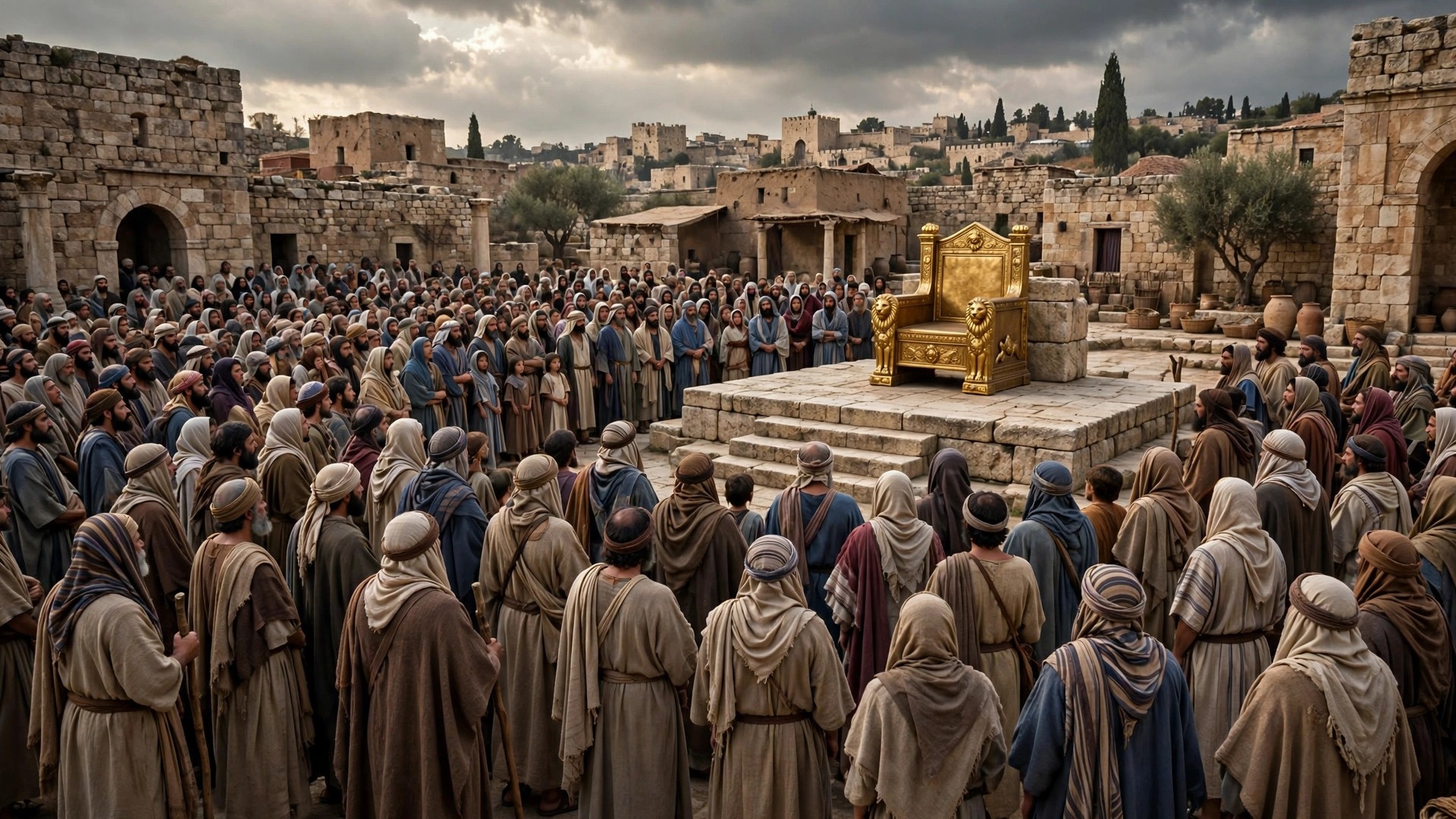
Imagine being part of a nation whose King is God Himself. No palace intrigue, no corrupt rulers, no crushing taxes — just the Lord Almighty leading you with perfect wisdom and love. That was Israel’s privilege. And then, one day, they threw it away. They looked at the nations around them and said, “Give us a king like all the other nations have.” The Israel rejecting God as king meaning in the Bible is one of the saddest — and most personally convicting — stories in Scripture, because it holds up a mirror to every heart that has ever preferred something visible over the invisible God. This is not just ancient history. It is the story of what happens whenever we trade God’s rule for something that looks more impressive.
Israel’s Unique Government: A Theocracy
From the time of Moses through the period of the judges — about 400 years — Israel had no human king. God was their King (Exodus 15:18, Isaiah 33:22). He led them through Moses, guided them with prophets, and raised up judges like Deborah, Gideon, and Samson in times of crisis. It wasn’t always smooth — the book of Judges honestly records that “everyone did as they saw fit” (Judges 21:25) — but the design was clear: God Himself would rule His people. Israel was meant to be a kingdom of priests, a holy nation (Exodus 19:6) — a people whose King was in heaven, whose law was God’s law, and whose glory was God’s presence.
The Demand for a King
In 1 Samuel 8, the elders of Israel came to the prophet Samuel with a demand: “You are old, and your sons do not follow your ways; now appoint a king to lead us, such as all the other nations have” (1 Samuel 8:5). Samuel was deeply upset. He prayed, and God gave him a stunning answer: “It is not you they have rejected, but they have rejected me as their king” (1 Samuel 8:7). God saw past the political request to the spiritual reality. The demand for a human king was, at its core, a rejection of God’s kingship.
Notice the reasons the elders gave. Samuel was old. His sons were corrupt (1 Samuel 8:3). The Philistines were threatening. Every reason sounded practical. But beneath the practical reasons was a spiritual one: they wanted a king they could see. God’s rule was invisible, mediated, slow. A human king would be visible, immediate, impressive. They traded the invisible King for a visible one — and that trade is the oldest temptation in the world.
God’s Warning: What a King Will Cost
God told Samuel to warn the people about what a king would cost them. The warning is detailed and sobering (1 Samuel 8:11–18): He will take your sons for his army and his work. He will take your daughters to serve in his palace. He will take the best of your fields, vineyards, and olive groves. He will take a tenth of your grain and flocks. “You yourselves will become his slaves.” God was saying, in effect: You think a king will make you free and strong? He will make you servants. I have been your King without taxing you into slavery.
The warning is a pattern that has repeated ever since. Every time God’s people trade His rule for human power, the bill comes due. The king you wanted to save you becomes the king who taxes you, conscripts you, and disappoints you. God’s warning was not a threat; it was a mercy — a last chance to reconsider before the consequences began.
The People Insist: “No! We Want a King”
Despite the warning, the people refused to listen. “No! We want a king over us. Then we will be like all the other nations, with a king to lead us and to go out before us and fight our battles” (1 Samuel 8:19–20). Read that sentence again: “like all the other nations.” That was the heart of it. Israel was called to be unlike the nations — set apart, holy, different. And they prayed to be ordinary. They wanted to blend in. They wanted a king to fight their battles — forgetting that God had been fighting their battles since Egypt.
And God gave them what they asked for. “Listen to them and give them a king” was His answer. This is one of the most sobering truths in Scripture: God sometimes answers our prayers by giving us what we demand — and letting us learn the hard way. “He gave them what they asked for, but sent a wasting disease upon them” (Psalm 106:15). The gift became the judgment. God’s “yes” to a foolish prayer is not His approval; it is His discipline.
The Consequences: What Happened Next
God gave Israel Saul — tall, handsome, impressive, exactly the king they wanted (1 Samuel 9:2). Saul started well but soon disobeyed: he offered a sacrifice he had no right to offer (1 Samuel 13:8–14) and spared what God commanded him to destroy (1 Samuel 15:23). God rejected Saul and chose David — “a man after his own heart” (1 Samuel 13:14). David’s reign brought glory, but even David fell into adultery and murder. Solomon’s reign brought splendor — and then idolatry (1 Kings 11:1–8). The kingdom split. The northern kingdom fell to Assyria; the southern kingdom fell to Babylon. The whole tragic arc began with a single prayer: “Give us a king like all the other nations have.”
Yet even in the consequences, God’s grace did not run out. Through David’s line, God promised an everlasting kingdom: “Your house and your kingdom will endure forever before me” (2 Samuel 7:12–16). The human kings failed, but the promise survived them — because the promise was never really about them. It was about the King who was coming.
Why Did Israel Reject God as King?
The reasons are painfully familiar. Fear. The Philistines were real, and a visible army felt safer than an invisible God. Impatience. God’s ways are slow; a king is fast. Comparison. “Like all the other nations” — the desire to be normal, to fit in, to have what everyone else has. Control. A human king can be managed, pressured, and replaced. God cannot. And distrust. Beneath all the reasons was a quiet disbelief that God was enough. Every one of these reasons still drives our rejections of God’s kingship today. We trade Him for careers, for relationships, for politics, for comfort — for anything visible, immediate, and impressive. The elders’ prayer is our prayer whenever we say, “God, I’ll take it from here.”
Every Heart Has a Throne
The deepest lesson of 1 Samuel 8 is not political; it is personal. Every heart has a throne, and someone sits on it. If God does not, something else will: your career, your reputation, your comfort, your fear, your appetites. Jesus put it bluntly: “No one can serve two masters” (Matthew 6:24). You cannot have God as Savior and something else as king. The question is not whether you have a king; it is which king you have.
And here is the gospel hidden in the story: the King Israel rejected became the King who died for them. The people who demanded a king “like all the other nations” got their wish — and then God gave them the King they actually needed. Jesus, the Son of David, the King of kings (Revelation 19:16), came not with an army but with a cross. He did not take their sons for His army; He gave His life for their sins. He did not take their fields; He gave them His kingdom. He did not make them slaves; He made them sons and daughters. The King they rejected is the King who redeemed them.
Jesus Is the King Israel Was Really Looking For
Israel wanted a king to fight their battles. Jesus fought the greatest battle — against sin, death, and the devil — and won it alone. Israel wanted a king to make them like other nations. Jesus made them unlike any nation — a holy people, a royal priesthood (1 Peter 2:9), a kingdom that will never end. The angel told Mary her child would receive “the throne of his father David, and he will reign over Jacob’s descendants forever; his kingdom will never end” (Luke 1:32–33). The wise men came asking, “Where is the one who has been born king of the Jews?” (Matthew 2:2). Pilate’s sign above the cross — “Jesus of Nazareth, King of the Jews” (John 19:19) — was truer than Pilate knew. The King Israel rejected is reigning now, and His kingdom will outlast every human empire.
Practical Faith Lessons From Israel’s Rejection
Beware the prayer “make me like everyone else.” God called you to be set apart, not to blend in. The desire to be normal is often the desire to escape God’s kingship. Beware of demanding what God has warned against. If Scripture warns you about a path, do not pray your way past the warning. God may give you what you insist on — and you may regret it. Trust God’s invisible rule over visible power. The king you can see is not the king who saves you. The God you cannot see is the one who has never lost a battle. And surrender the throne daily. Every morning, pray: “God, You are my King today. Not my feelings, not my fears, not my ambitions. You.” A throne surrendered daily is a life governed by grace.
Questions People Ask
Was it wrong for Israel to want a king at all? Not entirely. God had anticipated kingship (Deuteronomy 17:14–20) and promised David an everlasting throne. The sin was not wanting a king; it was rejecting God as King — wanting a king instead of God, on their terms, for their reasons. Motive matters. A king under God is a blessing; a king instead of God is a curse.
Does God still give people what they demand? Sometimes, yes — and it is one of His most sobering forms of discipline. “He gave them what they asked for” (Psalm 106:15). That is why we should pray with submission: “Your kingdom come, your will be done” (Matthew 6:10) — not “my kingdom come, my will be done.”
Conclusion: A Hopeful Ending — The King Who Never Fails
Israel rejecting God as king is one of the saddest stories in Scripture — but it is not the end of the story. The God they rejected did not abandon them. He gave them kings, then judged their kings, then promised a King who would never fail. That King has come. His name is Jesus. He is gentle and lowly in heart (Matthew 11:29). He washes His disciples’ feet (John 13:5). He dies for His enemies (Romans 5:8). And He reigns forever. The throne of your heart does not have to belong to fear, to comparison, to control, or to the next impressive thing. It belongs to the King who loved you, died for you, and rose again. Crown Him today. Surrender the throne. And discover what Israel missed for so long: that having God as your King is not a burden — it is the greatest freedom in the world. For historical context on the kingdom Israel’s demand created, see the Wikipedia article on the united monarchy of Israel.










