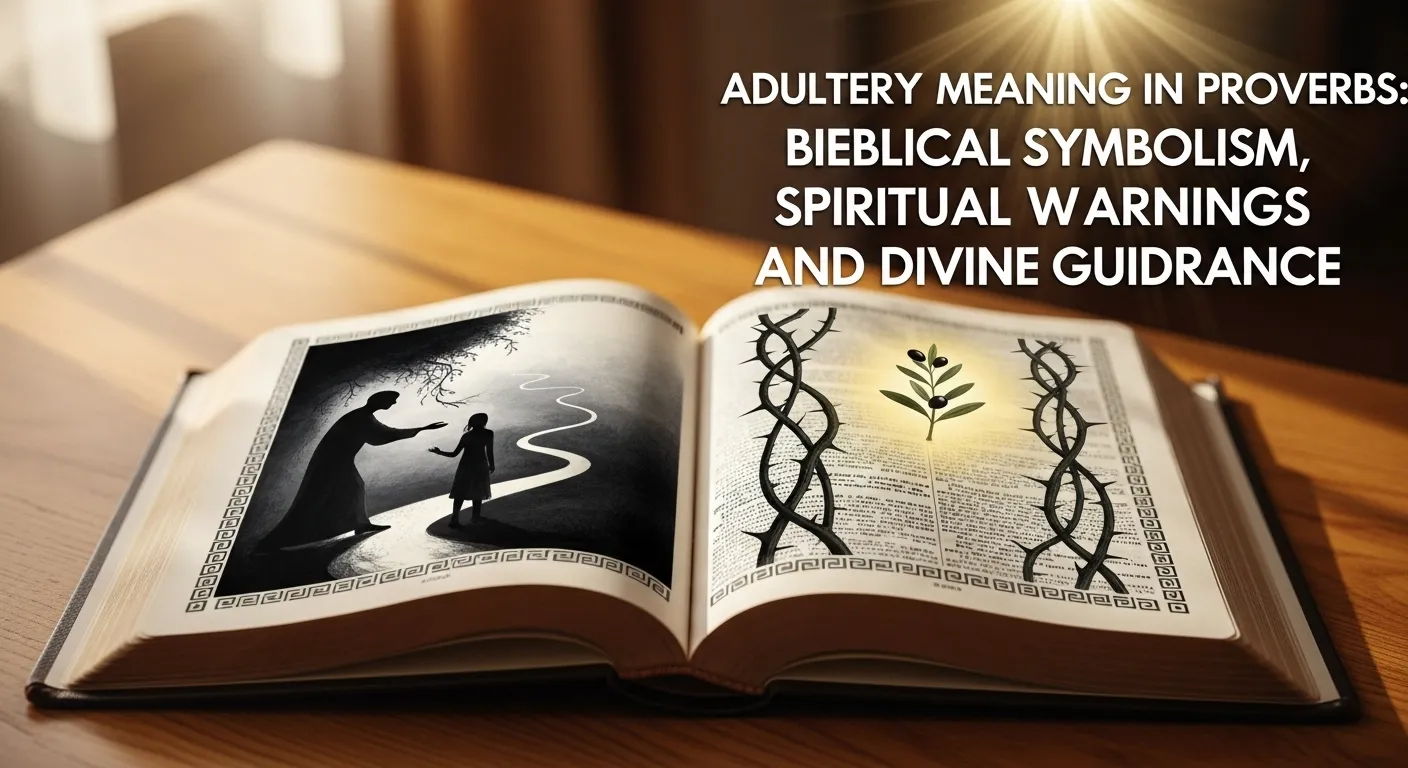
Proverbs tells one story longer than any other, and it is not about money, work, or kings. It is about a young man, a dark street, and a voice calling from a doorway. Chapters 5 through 7 return to this scene again and again, circling it like a warning beacon: a “forbidden woman” whose lips drip honey, whose words are smoother than oil, and whose house, the book says plainly, is the way to the grave. Modern readers sometimes skim these chapters as an outdated lecture on sexual ethics. That misses the point so completely that it inverts it. Proverbs is not primarily warning about a woman. It is warning about a pattern — the pattern by which temptation of every kind seduces the human heart. Adultery is the case study. The lesson is universal.
Honey on the Lips, Wormwood at the End
Proverbs 5:3-4 gives the pattern in two verses: “For the lips of an immoral woman drip honey, and her mouth is smoother than oil; but in the end she is bitter as wormwood, sharp as a two-edged sword.” Every temptation in human experience follows this exact arc: sweet at the entrance, bitter at the exit. The honey is real — Proverbs never claims sin is unpleasant at first. That is precisely what makes it dangerous. If temptation arrived tasting like wormwood, no one would touch it. It arrives tasting like honey, and the bill comes due later, with interest.
This is why Proverbs spends so much time on the beginning of the story rather than the end. The young man of Proverbs 7 does not wake up one morning resolved to ruin his life. He takes a walk at twilight, “in the evening, in the black and dark night” (Proverbs 7:9). He drifts toward the wrong street. He lingers. He listens. Each step is small, each one defensible, each one moving him one degree off course — until the degrees add up to a destination he never chose. Proverbs is teaching the geometry of moral failure: nobody falls off a cliff; people walk toward cliffs one unexamined step at a time. The warning is not “do not commit adultery.” The warning is “do not take the walk.”
The Trap Is Set Long Before the Door
Read Proverbs 7 carefully and notice who is active. The young man is described as “devoid of understanding” — literally, lacking heart. He is not evil; he is empty. He has no convictions occupying the space where temptation wants to move in, so temptation moves in unopposed. The woman, meanwhile, is all strategy: she dresses for the hunt, she flatters, she handles objections before they are raised, she creates urgency (“I have peace offerings with me… I have come out to meet you”). Proverbs is showing that temptation is never passive. It hunts. The only question is whether the heart it hunts is guarded or vacant.
And then the devastating simile: “He goes after her as an ox goes to the slaughter, or as a fool to the correction of the stocks” (Proverbs 7:22). The ox does not know it is walking to slaughter. That is the point. The most dangerous moment in the story is the moment that feels safest — the moment of surrender, when resistance ends and the heart says yes. Proverbs wants the reader to feel the horror of that unknowing. The young man thinks he has found pleasure. The reader, given God’s perspective, sees a man walking into a trap with his eyes open and his understanding shut.
Drink From Your Own Cistern
Proverbs does not only warn; it offers the alternative, and the alternative is beautiful. Proverbs 5:15: “Drink water from your own cistern, and running water from your own well.” Then verse 18: “Let your fountain be blessed, and rejoice with the wife of your youth.” The Bible’s answer to forbidden desire is not repression — it is covenant joy. Faithfulness is not presented as the grim duty of the deprived; it is presented as a well of your own, water that is yours, sweet because it is given and kept. The world says faithfulness is missing out. Proverbs says faithfulness is the only water that actually quenches thirst, because stolen water always runs out and leaves the thief thirstier than before.
This is one of the most countercultural claims in Scripture, and Proverbs makes it without embarrassment: lasting satisfaction is found not in novelty but in loyalty. The forbidden woman promises excitement; the covenant promises depth. Excitement fades by morning. Depth compounds over decades. Every long, happy marriage is an exhibit in Proverbs’ favor — not because those couples never faced temptation, but because they kept drinking from their own well while the world drank from puddles and called it freedom.
Guarding the Gates: Practical Wisdom
Proverbs is relentlessly practical about prevention, because it knows that willpower at the moment of temptation is the weakest defense. The strongest defense is distance, arranged in advance. Proverbs 5:8: “Remove your way far from her, and do not go near the door of her house.” Not near — far. The wise person does not test how close to the edge he can stand; he builds his life at a distance from the edge. This is the opposite of the modern game of seeing how much compromise can be survived. Proverbs calls that game what it is: folly.
Job articulated the same principle centuries earlier: “I have made a covenant with my eyes; why then should I look upon a young woman?” (Job 31:1). A covenant with the eyes — a decision made in the clear light of morning about what the eyes will and will not do in the dark of night. Jesus raised the standard higher still: “Whoever looks at a woman to lust for her has already committed adultery with her in his heart” (Matthew 5:28). The battle is won or lost in the imagination before it ever reaches the body. And when temptation is already close, the Bible’s command is not “stand and fight” but flee: “Flee sexual immorality” (1 Corinthians 6:18). Joseph, faced with Potiphar’s wife, did not stay to reason with her — he ran, leaving his garment behind (Genesis 39:12). There is no shame in flight. The shame is in staying.
Build the hedges before you need them: guard what you watch and read, be honest with a trusted friend or counselor about struggles, keep your marriage (or your future marriage) in active cultivation rather than passive assumption, and never confuse secrecy with privacy. Temptation thrives in isolation; it withers in the light of honest community. The young man of Proverbs 7 walked alone at twilight. Walk in the light, with companions, and the forbidden door loses its pull.
The Deeper Unfaithfulness
The prophets take Proverbs’ warning one level deeper, and honest readers should follow them there. Throughout Scripture, God describes His people’s idolatry as adultery — not metaphorically as a stretch, but as the exact same betrayal in spiritual form. When Israel chased other gods, the prophets called it whoring after lovers. The marriage covenant between God and His people is the template, and every other covenant echoes it. This means Proverbs’ “forbidden woman” is also a picture of every rival lover the heart takes: the ambition that demands your Sundays, the resentment you nurse like an affair, the comfort you run to instead of God.
Ask the searching question Proverbs is really asking: who or what are you being unfaithful to God with? The man in Proverbs 7 was unfaithful to his marriage vows. But the deeper warning is for the reader who would never commit physical adultery yet commits spiritual adultery daily — giving to lesser loves the devotion that belongs to God alone. James 4:4 picks up the prophets’ language: friendship with the world is enmity with God. The heart, like the body, was made for covenant. It cannot be faithful to two masters.
The Way Back
Proverbs’ warning would be cruelty if there were no way back, but the whole Bible is the story of the way back. David committed the very sin Proverbs warns about — adultery compounded with murder — and Psalm 51 is his road home: “Create in me a clean heart, O God.” The woman caught in adultery in John 8 met Jesus and heard two sentences that hold the whole gospel: “Neither do I condemn you” — grace — “go and sin no more” — truth. Grace without truth is permission; truth without grace is crushing. Jesus gives both, and both are needed for the rebuilding.
For the reader who recognizes himself in the young man of Proverbs 7 — whether the struggle is with lust, with pornography, with an emotional entanglement, or with the slow drift of a divided heart — the path is the same one David walked: honest confession to God, ruthless removal of the occasions (stop taking the walk; Proverbs 5:8 says remove your way far from her — not near, far), and accountable community. Shame grows in secrecy; healing grows in the light. And for the reader who has been betrayed rather than betrayer, Proverbs offers no cheap comfort — but the God of Proverbs is the God who binds up the brokenhearted, and faithfulness betrayed by another is never faithfulness wasted before Him.
The honey still drips from a thousand lips in a thousand forms, and it still turns to wormwood by morning. But the well is still there too — deep, clear, and yours. Drink from it, and find that the loyalty the world calls boring is the only adventure that does not end in ruin. For historical and cultural context on how this ancient command has been understood across centuries and civilizations, the article on adultery traces its legal and social history in detail — a useful backdrop for appreciating just how radical Proverbs’ vision of covenant faithfulness was in its own time, and remains in ours.










