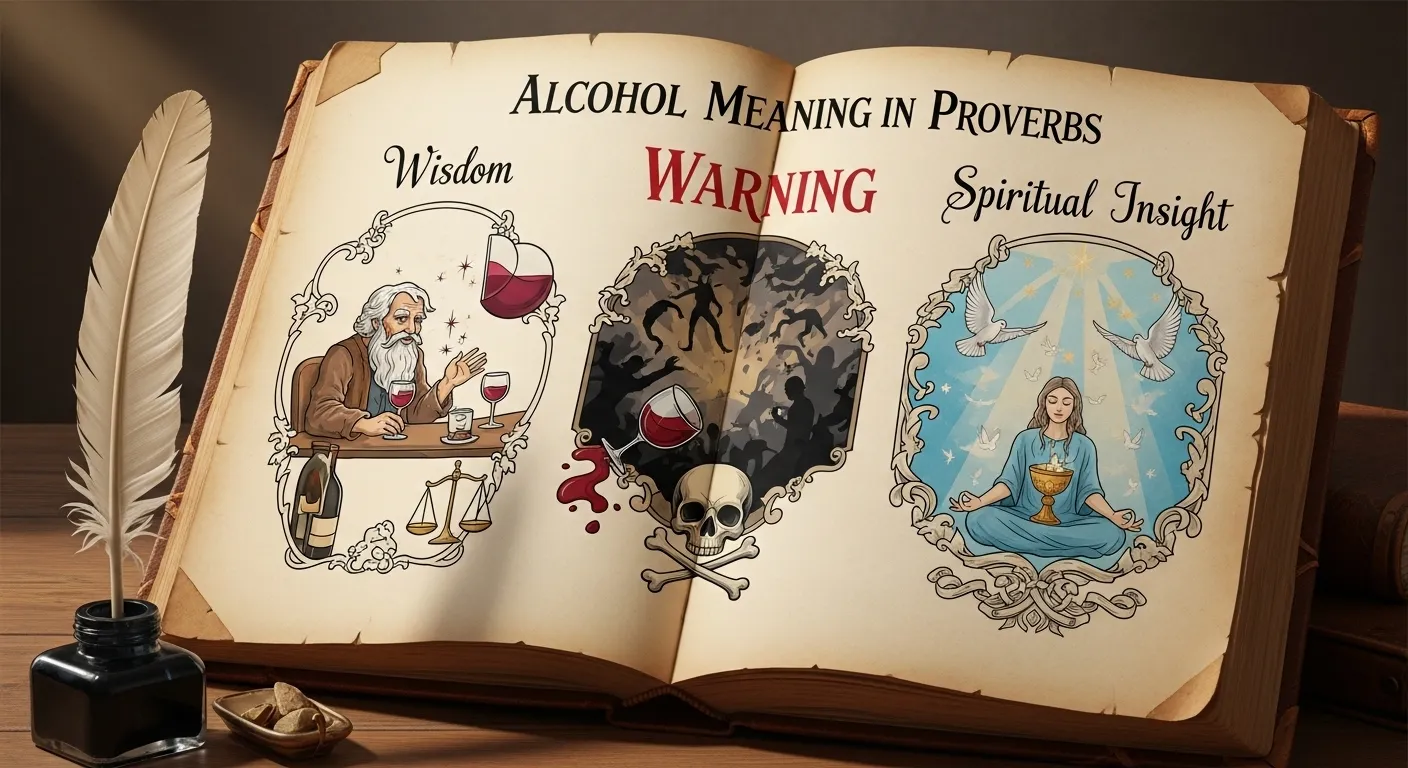
Wine in the Bible wears two faces, and Proverbs wants you to recognize both. In one passage it gladdens the heart; in another it mocks the drinker, bites like a serpent, and leaves a trail of wounds, sorrow, and red eyes. This is not contradiction. It is honesty. Proverbs refuses both the preacher who says alcohol is pure evil and the reveler who says it is pure fun. Instead it asks a deeper question than “Is drinking a sin?” It asks: what is mastering you? The answer to that question determines whether wine is a servant at your table or a master in your house.
The Mocker in the Cup
Proverbs 20:1 fires the opening warning: “Wine is a mocker, strong drink is raging, and whoever is deceived thereby is not wise.” The imagery is deliberate. Wine mocks — it promises confidence and delivers embarrassment, promises relaxation and delivers regret, promises freedom and delivers bondage. It is raging, like an unchained animal. And the person deceived by it — the one who believed the promises — is, in Proverbs’ blunt assessment, not wise. Not wicked, not hopeless: unwise. The door of wisdom is still open, but the drinker is currently standing outside it, laughing at jokes he will not find funny in the morning.
Proverbs 23:29-35 is the book’s fullest portrait of where that road ends, and it reads like a coroner’s report written in poetry: “Who has woe? Who has sorrow? Who has contentions? Who has complaints? Who has wounds without cause? Who has redness of eyes? Those who linger long at the wine.” Notice the questions. Proverbs does not begin with condemnation; it begins with symptoms, inviting the reader to do the diagnosis himself. Woe, sorrow, fights, complaints, unexplained wounds, bloodshot eyes — this is not a sermon illustration. It is a medical chart. And the diagnosis is written in verse 35, in the voice of the drinker himself: “They struck me, but I was not hurt… When shall I awake, that I may seek another drink?” That last line is the whole tragedy in eleven words: the pain no longer teaches, because the craving has outgrown the pain.
Do Not Even Look
Proverbs 23:31 gives the preventive counsel: “Do not look on the wine when it is red, when it sparkles in the cup, when it swirls around smoothly.” This is striking because it targets the beginning of the process, not the end. Do not look. Do not admire. Do not linger over the color and the sparkle. Proverbs understands the anatomy of temptation: it starts with the gaze, moves to the imagination, and ends in the act. By the time you are deciding whether to take the drink, the battle is mostly over — it was won or lost when you decided whether to look.
The verse goes on: “At the last it bites like a serpent, and stings like a viper.” The serpent does not announce itself. It waits in the grass, beautiful and still, and strikes when the hand is close. Proverbs says alcohol works the same way. The first glass sparkles; the last one bites. This is why the book’s counsel is not “drink moderately” or “know your limit” — it is do not start down the path of admiration. The wisdom is preemptive. Guard the eyes, and the hands will follow.
This principle reaches far beyond alcohol. Proverbs uses wine as a case study in a universal pattern: anything that promises pleasure while quietly demanding mastery follows the same script. The application each reader must make is personal: what is the “wine” in your life — the thing that sparkles in the cup but bites at the last? Name it honestly, and Proverbs 23:31 applies to it word for word.
The Surprising Balance: Proverbs 31
Intellectual honesty requires facing Proverbs 31:6-7: “Give strong drink to him who is perishing, and wine to those who are bitter of heart. Let him drink and forget his poverty, and remember his misery no more.” Proverbs does not pretend wine has no legitimate use. In a world without anesthesia or antidepressants, wine was medicine for the dying and relief for the crushed. The Bible acknowledges human pain; it does not sneer at the desire for relief.
But read carefully: this is wine as medicine for the perishing, not as a lifestyle for the living. The passage describes an exception for extreme suffering, not a rule for Friday nights. And even here, the very next verses pivot to the king’s duty: to judge righteously and defend the poor (Proverbs 31:8-9). The book will not let wine become the center of anyone’s life — not the sufferer’s, and certainly not the leader’s. For kings and rulers, Proverbs 31:4 is explicit: “It is not for kings to drink wine… lest they drink and forget the law.” Responsibility and intoxication are enemies. The more your decisions affect others, the less room there is for anything that clouds judgment.
The New Testament’s Balanced Voice
The New Testament keeps Proverbs’ balance with remarkable consistency. At the wedding in Cana, Jesus’ first recorded miracle was turning water into wine — good wine, the master of the feast said, the best (John 2:1-10). Whatever one’s personal convictions about drinking, the text will not support the claim that wine itself is evil; Jesus made it, served it, and was even accused by His enemies of being a “winebibber” precisely because He did not abstain like John the Baptist did (Matthew 11:19). Paul advised Timothy to use a little wine for his stomach ailments (1 Timothy 5:23). Scripture’s world is one where wine is a normal, God-given good.
And in the same breath, the New Testament roars Proverbs’ warnings at full volume. “Do not be drunk with wine, in which is dissipation; but be filled with the Spirit” (Ephesians 5:18). Drunkenness is listed among the works of the flesh that war against the soul (Galatians 5:21; 1 Peter 4:3). Church leaders are held to strict standards of sobriety (1 Timothy 3:3; Titus 1:7). The line the New Testament draws is exactly Proverbs’ line: the gift is good, the mastery is the danger. 1 Corinthians 6:12 states the principle for every gray area in the Christian life: “All things are lawful for me, but I will not be brought under the power of any.” The question is never only “is this permitted?” It is “is this mastering me?”
Romans 14 adds the final, often-forgotten dimension: love for the weaker brother. “It is good neither to eat meat nor drink wine nor do anything by which your brother stumbles” (Romans 14:21). Even a liberty you legitimately hold becomes wrong the moment it wrecks someone else’s faith. The mature believer in Proverbs’ vision is not the one who can drink the most without visible damage; it is the one whose freedom is governed by wisdom and whose wisdom is governed by love. That is the clarity Proverbs was after all along.
The Real Question: What Controls Your Heart?
Step back, and Proverbs’ message about alcohol resolves into a single searching question: what controls your heart? The book’s concern was never really the liquid in the cup. It was the lordship in the life. Anything that dulls conscience, loosens restraint, and makes wisdom harder to hear is spiritually dangerous — whether it comes in a bottle or not. Alcohol is simply Proverbs’ clearest example, because its effects are so visible: the mocker, the brawler, the red eyes, the morning-after vow to do it again.
This is also where hope enters. Proverbs’ warnings are not written to shame people who struggle; they are written to rescue them. The book assumes change is possible. And for those for whom drinking has moved beyond choice into compulsion — where the craving outgrows the pain, as Proverbs 23:35 describes — the biblical response is not willpower alone. It is honest confession, the support of wise and trustworthy people, prayer, and, where needed, professional help. There is no shame in needing a counselor, a doctor, or a recovery community; Proverbs 11:14 says that in the multitude of counselors there is safety. God heals through means, and using them is wisdom, not weakness.
Walking in Clarity
Proverbs’ positive vision is a life of clarity: a clear mind, a steady hand, a conscience with nothing to hide. The wise person of Proverbs is awake — alert to temptation, honest about weakness, quick to pray, surrounded by counsel. Ephesians 5:18 draws the New Testament line with matching bluntness: “Do not be drunk with wine… but be filled with the Spirit.” It is a contrast of fillings. Every heart will be filled with something. Proverbs asks you to choose your filling deliberately: the Spirit’s clarity, or the cup’s fog.
So the next time the wine sparkles in the cup — or the next time anything sparkles with the same promise of relief without cost — remember the serpent in the grass and the mocker in the bottle. Remember the red eyes and the unanswered questions of Proverbs 23. And remember that the God who warns you is the God who loves you, who would rather you be free and clear-eyed than comfortably numb. For a wider view of how different faiths have wrestled with this same tension between celebration and caution, the article on religion and alcohol surveys the remarkable variety of religious responses — and shows, across traditions, the same underlying conviction Proverbs voices: that what masters the mind shapes the soul.










