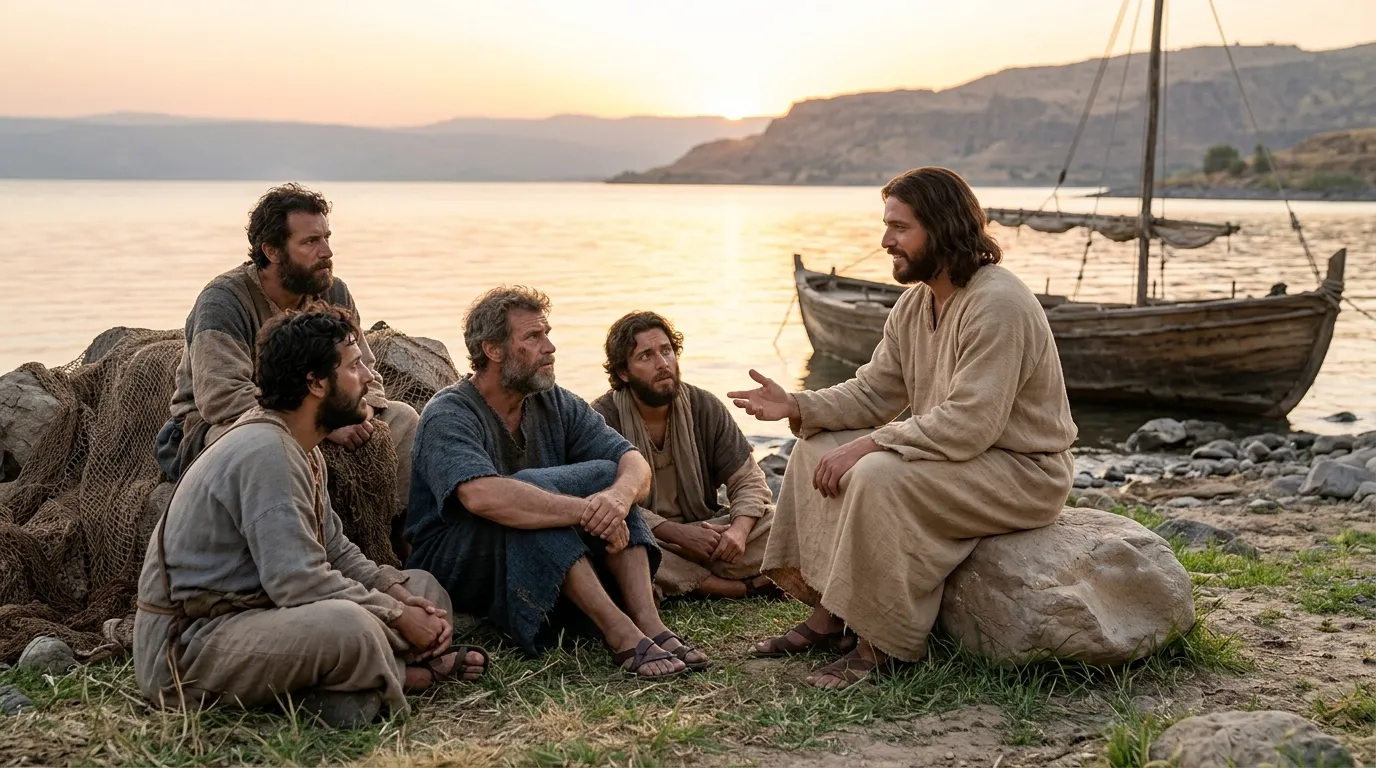
Jesus spent three years with twelve men, and the method He used is worth studying — because it is still His method. He did not run a school with lectures and exams. He did not write a manual. He called ordinary men to follow Him, lived with them, showed them, sent them, corrected them, and finally commissioned them to change the world. The result: eleven of the twelve (and then Paul, the exception who proves the rule) turned the empire upside down.
This article examines Jesus’ training method the way a teacher might study a master: by observing the stages. Calling, proximity, demonstration, delegation, correction, and commission — each stage has a logic, and the logic still shapes how disciples are made today.
Calling: “Follow Me”
It starts with two words. To fishermen mending nets: “Follow me, and I will make you fishers of men.” To Matthew at the tax booth: “Follow me.” The call is personal, not institutional. Jesus does not advertise for applicants or interview candidates. He chooses — “You did not choose me, but I chose you” — and the choosing is sovereign, specific, and disruptive. Nets are left. Booths are abandoned. Lives are interrupted.
Note what the call does not include: no entrance requirements, no literacy tests, no character references. Fishermen, a tax collector, a zealot (a former revolutionary), a thief (Judas, chosen knowingly). The qualifications are supplied after the calling, not before it. “I will make you” — the making is His work. The disciple’s part is the following. This is the foundation of all Christian formation: God calls the unqualified and qualifies the called.
The call also establishes the method’s core: proximity. “Follow me” means, literally, walk behind me. Go where I go. See what I see. The training will happen not in a classroom but on the road — in boats, at tables, in villages, on mountains. Discipleship, from the first word, is immersive.
Proximity: Life Together
Mark’s summary of the appointment is revealing: Jesus appointed twelve “so that they might be with him and he might send them out to preach.” Being with Him comes before being sent by Him. The order is non-negotiable. The disciples’ primary curriculum is presence — three years of watching how Jesus prays, how He treats the marginalized, how He handles opposition, how He rests, how He weeps.
This is formation by contagion. Character is caught more than taught. The disciples absorb Jesus’ compassion by watching Him touch lepers, His courage by watching Him face Pharisees, His prayer life by finding Him gone in the morning — “and he went out to a desolate place, and there he prayed.” They ask, “Lord, teach us to pray,” not because He lectured on prayer but because His praying made them hungry.
The modern church often reverses the order: send first, be-with later (or never). We recruit volunteers, assign tasks, and wonder why they burn out. Jesus’ method insists that doing flows from being. The twelve could preach the kingdom because they had lived in it for three years. Proximity is not inefficient. It is the efficiency of depth: slow formation that produces lasting fruit.
Demonstration: “Watch How I Do It”
Jesus constantly narrates His actions as templates. Washing the disciples’ feet: “I have given you an example, that you also should do just as I have done to you.” Forgiving: “Forgive… as the Lord has forgiven you.” Loving: “Love one another… just as I have loved you.” The method is show-then-tell: demonstrate the reality, then command the imitation.
The miracles function as demonstrations too — not just of power but of the kingdom’s character. Each healing is a parable in action: the kingdom restores, includes, liberates. The disciples watch hundreds of these object lessons before they are sent to perform their own. When Jesus later sends them with authority over disease and demons, they are not working from theory. They have seen it done, up close, for years.
There is a principle here for every discipler: never command what you have not modeled. The right to say “do as I do” must be earned by a life that can bear inspection. Jesus could say “follow me” because there was nothing in His following that would corrupt the follower. The closer the inspection, the brighter the example — which is why proximity and demonstration belong together.
Delegation: Sent Before They’re Ready
Perhaps the most startling stage: Jesus sends them out before they are ready. The mission of the twelve (Matthew 10) and the seventy-two (Luke 10) happens mid-training, not after graduation. They are given authority, instructed, and dispatched — and they return amazed: “Lord, even the demons are subject to us in your name!”
Jesus’ response is instructive: “I saw Satan fall like lightning from heaven” — affirming the victory — and then redirecting their joy: “Do not rejoice in this, that the spirits are subject to you, but rejoice that your names are written in heaven.” Delegation includes debriefing. Experience without reflection produces pride; experience processed with Jesus produces wisdom.
The pedagogy is clear: people learn by doing, not just by watching. The disciples needed the shock of their own inadequacy met by Christ’s authority working through them. Every discipler faces the temptation to wait until people are “ready.” Jesus’ method says: prepare them, pray for them, then send them — and be there when they return, to interpret what happened.
Correction: The Hard Conversations
Jesus corrects constantly, and the corrections are unsparing. Peter’s rebuke of the cross-prediction earns the sharpest words in the Gospels: “Get behind me, Satan!” The disciples’ argument about greatness is answered by placing a child among them. Their failure to cast out a demon is diagnosed: “This kind cannot be driven out by anything but prayer.” James and John’s request for thrones is refused with a question about drinking cups and baptisms.
But notice the tone underneath the sharpness: He never gives up on them. The corrections are surgical, not punitive — aimed at the disease (pride, unbelief, ambition), never at the person. Even Judas receives the bread at the table and the words “What you are going to do, do quickly” — sorrow, not rage. Correction in Jesus’ school is always redemptive in intent, even when it wounds in the moment.
The disciples’ slowness is almost comic — three passion predictions, and they are still arguing about greatness on the way to Jerusalem — but Jesus’ patience is the real lesson. Formation takes time. People misunderstand repeatedly. The master teacher does not expel slow students. He keeps teaching, keeps correcting, keeps believing in what they will become. “You are those who have stayed with me in my trials” — He honors their perseverance even while correcting their blindness.
The Failure Built Into the Method
Honesty about the method requires noticing its most uncomfortable feature: it includes Judas. Jesus chose him, lived with him, demonstrated to him, sent him out (he performed miracles on the mission of the twelve), corrected him — and Judas betrayed Him anyway. The perfect Teacher, the perfect method, and one student is lost. “None of them is lost but the son of destruction, that the Scripture might be fulfilled.”
This is both a warning and a comfort. A warning: proximity to Jesus does not automatically produce faithfulness. It is possible to be with Him for three years, see everything, do mighty works — and still choose the thirty pieces of silver. Exposure is not the same as surrender. A comfort: when our own discipling efforts fail — when the mentored walk away, when the invested-in betray the investment — we are in good company. The failure does not necessarily indict the method or the teacher. Some soil, as the parable says, simply does not bear fruit.
The method’s success rate, humanly speaking, was eleven out of twelve — and the eleven changed the world. No discipler should expect better than the Master got, and no discipler should accept less effort than the Master gave. Call, proximity, demonstration, delegation, correction, commission — practiced with patience, entrusted with prayer, and released to God for the results.
Commission: “As the Father Sent Me”
It culminates after the resurrection. The training is complete — or rather, the foundation is laid, and the Spirit will complete it. “As the Father has sent me, even so I am sending you.” The commission mirrors the calling: as He was sent, they are sent. The method reproduces itself. Disciples make disciples who make disciples, in an unbroken chain from Galilee to the present.
The final instructions gather every stage: teach what I commanded (the content of the proximity years), baptize (the initiation into the new following), make disciples of all nations (the delegation, now global), and the promise that makes it possible — “I am with you always.” The proximity that began with “follow me” ends with “I am with you”: the with-ness continues, now by the Spirit, in every disciple, to the end of the age.
This is why the church still exists. The training worked — not because the students were exceptional but because the Teacher was. Eleven frightened men in an upper room became, within a generation, a movement that outlasted the empire that executed their Master. The method — call, proximity, demonstration, delegation, correction, commission — is still producing the same results wherever it is practiced. It is slow. It is personal. It is inefficient by every modern metric. And it is the way Jesus chose to change the world.
The historical and theological shape of this calling — what it has meant to be a learner-follower of Jesus across the centuries — is surveyed in the article on discipleship in Christianity, from the Twelve to the present day.










