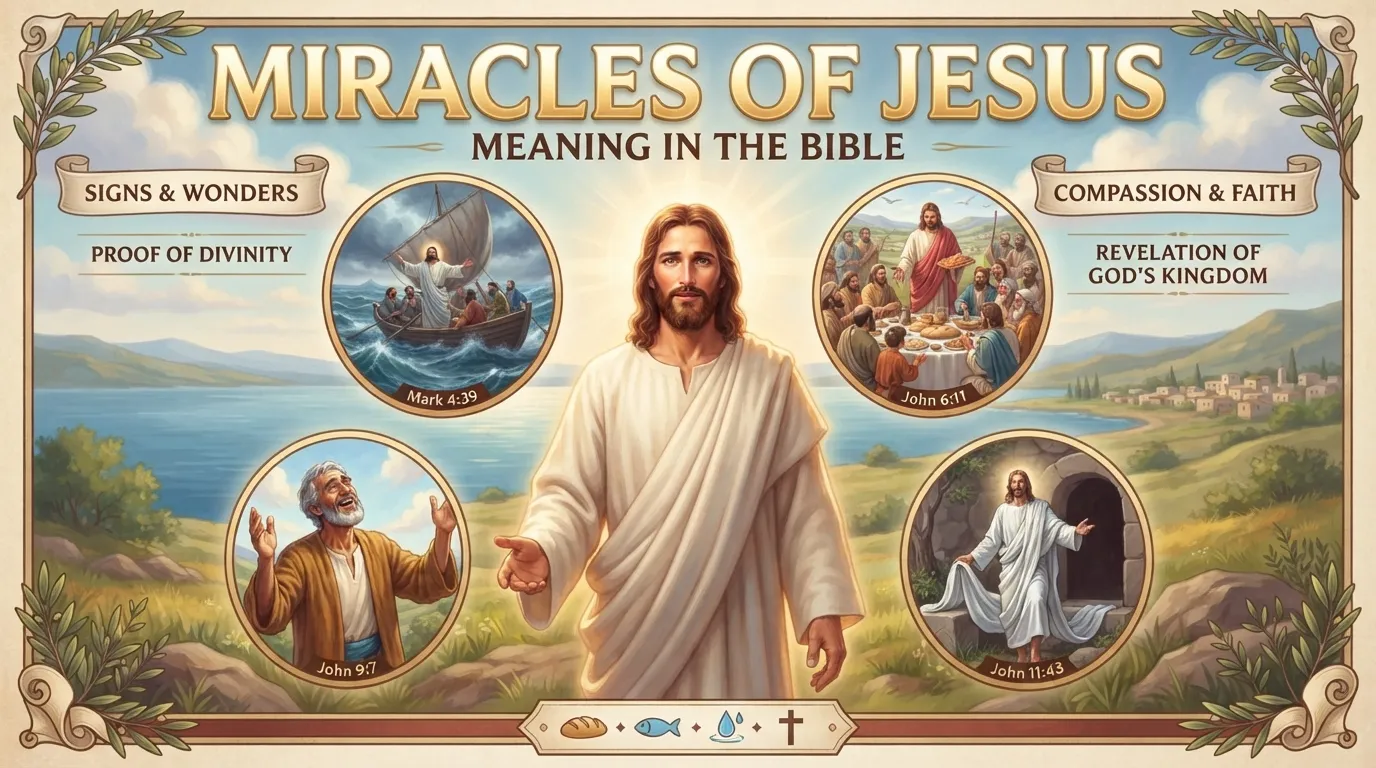
Imagine praying for something that feels impossible. Sickness, fear, financial pressure, family trouble, a season when you cannot see what comes next. In moments like these, the miracles of Jesus meaning in the Bible can bring deep hope. They show that Jesus cared about hurting people, had authority over creation, and revealed the power and character of God. But the Gospels are careful about what miracles are. They were not spectacles performed to impress crowds. They were signs — events that point beyond themselves toward who Jesus is and what God’s kingdom is like. John makes this explicit: the signs were written so that people would believe that Jesus is the Christ, the Son of God, and that through believing they may have life in His name (John 20:30–31). The central meaning of a miracle is not simply, “Something impossible happened.” The deeper message is, “Look at Jesus and understand what this reveals about God.”
Signs That Reveal Who Jesus Is
Jesus’ works demonstrated His unique authority. In Mark 2:1–12, Jesus healed a paralyzed man after first telling him that his sins were forgiven. The religious teachers questioned His authority to forgive sins. Jesus then healed the man. The physical healing supported His claim that the Son of Man has authority to forgive sins. The miracle pointed beyond the man’s legs. It pointed to Jesus’ authority over sin itself.
The language of Scripture reinforces this. The New Testament was written primarily in Greek, and John frequently uses semeion, meaning “sign,” for Jesus’ miracles — the word emphasizes that the miracle points beyond itself. The Gospels also use words related to dynamis, meaning “power,” and teras, meaning “wonder.” Behind these Greek terms stands the Hebrew background of the Old Testament: ‘ot, a “sign” that points to God’s activity or confirms His message; mophet, a “wonder” or extraordinary event demonstrating God’s power; and pala’, for things wonderful and beyond ordinary human ability. The New Testament describes Jesus’ miracles with Greek terms while drawing on the Old Testament understanding of God’s signs, wonders, and mighty acts.
Signs That Show Compassion
Jesus did not treat suffering people as interruptions. In Matthew 14:13–14, Jesus saw a large crowd, had compassion on them, and healed their sick. God’s power is connected with His compassion. Jesus’ miracles often involved people whom society overlooked — people who were sick, poor, rejected, afraid, or grieving.
In Mark 1:40–45, a man with leprosy approached Jesus and asked to be made clean. Jesus responded with compassion and healed him. The story reveals both Jesus’ authority and His willingness to touch someone who was socially isolated. And in Mark 5:25–34, a woman who had suffered from bleeding for many years reached out to Jesus in faith. Jesus responded to her and called her “Daughter.” Her story demonstrates courage, trust, and the compassionate attention of Christ. At the same time, the Bible does not present faith as a magical force. Faith is trust in God, not a technique for getting a desired outcome. Hebrews 11:1 describes faith as confidence in what is hoped for and conviction concerning what is not seen. Christian faith rests on God’s character and promises.
Signs of the Kingdom
Jesus’ miracles also showed what God’s kingdom was doing in the world. When Jesus cast out demons, healed sickness, and brought restoration, He demonstrated that God’s rule was confronting evil and suffering. In Matthew 12:28, Jesus connected His casting out demons with the arrival of God’s kingdom. The miracles were signs of God’s redemptive work.
The Gospels record many miracles, grouped into several broad categories. Jesus healed the sick — lepers, blind people, paralyzed people, those with fevers, people with long-term illnesses, people who were deaf or unable to speak. He controlled nature: in Mark 4:35–41, a violent storm threatened the disciples in a boat, and Jesus rebuked the wind and commanded the sea to be still. The disciples asked, “Who then is this?” — the question at the center of the story. The miracle was not simply about calm weather; it caused the disciples to think more deeply about Jesus’ identity and authority. He fed hungry people: in John 6:1–15, Jesus multiplied five barley loaves and two fish to feed a large crowd, and John uses the event to introduce deeper teaching about Jesus as the bread of life (John 6:35). He raised the dead — most powerfully Lazarus in John 11, where Jesus declared before the miracle, “I am the resurrection and the life” (John 11:25). And He cast out demons, as in Mark 5, where He delivered a man who had been severely tormented — accounts showing Jesus’ authority over spiritual evil. Scripture directs believers toward Christ, prayer, truth, and faith rather than fear.
What the Signs Teach About Faith
The spiritual meaning of the miracles can be understood through the truths they reveal. Healing can point to restoration — but Christians should be careful not to conclude that every illness will immediately disappear if someone has enough faith. Scripture does not teach that simple formula. Paul prayed about his own “thorn in the flesh,” yet God did not remove it in the way Paul requested (2 Corinthians 12:7–10). Faith means trusting God, not controlling God.
Calming the storm can point to trust. Jesus did not promise His disciples would never experience storms. He showed that He was with them in the storm. That can encourage a Christian facing anxiety, uncertainty, or a difficult season: you may not know what Jesus will do, but you can trust who Jesus is. Feeding the crowd can point to God’s provision — yet biblical provision does not mean believers will always receive everything they want. God’s provision can involve daily food, strength to continue, wise people who offer help, opportunities, peace, or grace for a difficult situation. Philippians 4:19 points believers toward God’s provision according to His riches in Christ.
Nor does the Bible support the idea that every miracle depends on a person’s level of faith. The Gospel accounts show different situations: some miracles occur in response to faith, while others demonstrate Jesus’ compassion or authority. And Christians differ in how they understand modern miracles and miraculous gifts. Scripture clearly teaches that God is able to act supernaturally, while Christians should still exercise discernment and avoid treating every unusual event as miraculous. If something wonderful happens — an unexpected recovery, an answered prayer, a narrow escape, provision, a remarkable opportunity — a Christian can respond with gratitude without becoming superstitious. If someone receives unexpected financial help during a difficult month, they can thank God while also recognizing the generosity of the person who helped them. Gratitude and wisdom can exist together.
Three Lessons for Today
First, bring your needs to Jesus. People repeatedly came to Jesus with their pain and needs. Christians can bring their concerns to God through prayer — health concerns, family problems, financial needs, fear about the future, grief, loneliness, spiritual struggles. Prayer does not require pretending everything is fine.
Second, do not measure God’s love by your circumstances. Sometimes a person prays for healing and remains sick. Another prays for a job and keeps waiting. Someone else prays for a relationship to be restored, yet the situation remains painful. The miracles of Jesus show God’s power, but they do not promise that every believer will receive an immediate miracle. God’s love is not measured by how quickly He answers one particular prayer.
Third, look beyond the miracle. The crowds often focused on what Jesus did. Jesus repeatedly directed people toward deeper truth. After the feeding of the five thousand, He taught about the bread of life. Do not only seek God’s gifts. Seek God Himself.
And the most important miracle of all? For Christian faith, the resurrection of Jesus stands at the center of the Gospel. The Gospels teach that Jesus was crucified, buried, and raised from the dead. Paul explains in 1 Corinthians 15 that the resurrection is foundational to Christian faith. The resurrection is not merely another miracle in a long list. It is central to the Christian message of sin, redemption, victory over death, and eternal life. Because Jesus rose, Christians have hope that death does not have the final word.
When you read the miracles, look beyond the question, “What happened?” Ask, “What does this show me about Jesus?” If you are waiting for an answer to prayer today, remember that biblical faith is not about forcing God to act in a certain way. It is about trusting Him even when the outcome is not yet clear. Bring your needs to God. Search Scripture. Pray with honesty. Give thanks for His grace. And when life feels impossible, remember the central message of the Gospel: Jesus is Lord, death does not have the final word, and God’s faithfulness can be trusted. May the miracles recorded in Scripture lead you not only to wonder, but to deeper faith, wisdom, gratitude, prayer, and trust in Jesus Christ. For a wide-ranging account of how miracle claims — biblical and otherwise — have been understood, debated, and investigated through history, the Wikipedia article on miracles provides a useful overview.










