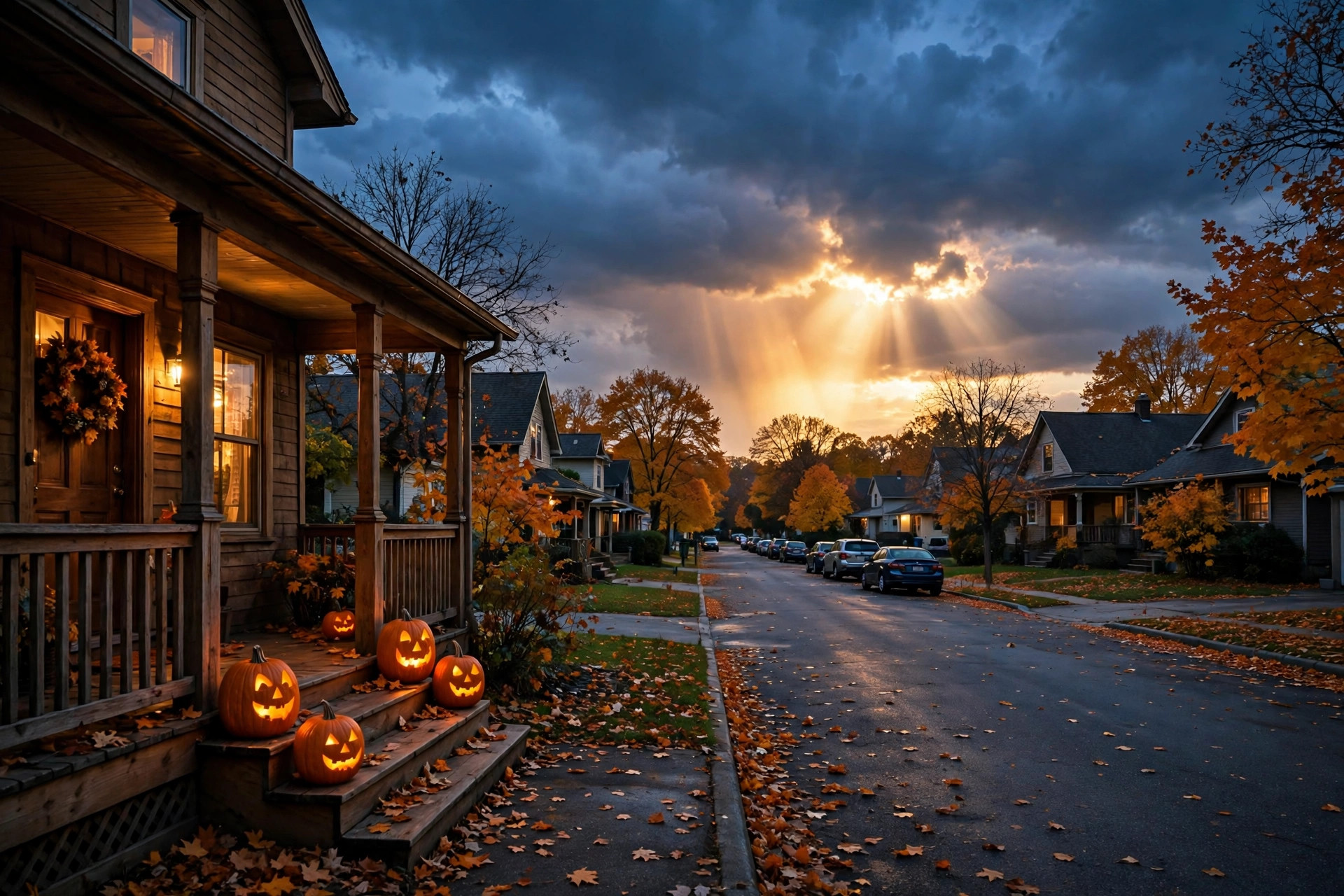
Every October the decorations go up. Plastic skeletons hang from porches, carved pumpkins grin from doorsteps, and children plan their costumes. For many families it feels like harmless fun. But thoughtful Christians feel a question lingering underneath it all: what does the Bible actually say about Halloween, and how should a follower of Jesus respond to it?
Here is the honest starting point: the Bible never mentions Halloween by name. The holiday as we know it took shape centuries after the New Testament was written. Yet Scripture speaks at length about darkness, evil spirits, witchcraft, and how God’s people should relate to them. Those teachings give us everything we need to think wisely about October 31. Let us begin with Scripture, with open hearts and clear minds.
The Night Before All Saints
It helps to know where Halloween came from. Its roots lie in Samhain (pronounced “sow-in”), the ancient Celtic festival marking the turn toward winter around November 1. The Celts believed that on this night the boundary between the living and the dead grew thin and spirits roamed the earth, so people wore frightening costumes to drive evil spirits away and left food out to appease them.
When Christianity spread through Celtic lands, the church set November 1 as All Saints’ Day — also called All Hallows’ Day — to honor Christian martyrs and saints. The evening before became “All Hallows’ Eve,” shortened over time to Halloween. Across the centuries, old pagan customs and the Christian observance blended together.
In America, Halloween grew into a community holiday of costumes, candy, and spooky fun, and most people celebrating today know nothing of its ancient roots. Still, Christians should ask: does the Bible give us guidance about a holiday with these origins?
Light Against Darkness in Scripture
Scripture is clear that evil spirits are real. Ephesians 6:12 tells us our struggle is “against the rulers, against the authorities, against the powers of this dark world and against the spiritual forces of evil in the heavenly realms.” The devil is real, demons are real, and spiritual warfare is real.
The Bible’s own vocabulary is rich here. The Hebrew word for darkness is choshek, which in Genesis 1 covers the deep before God says, “Let there be light” — darkness as spiritual blindness, not just absence of light. The Hebrew shedim, mentioned in Deuteronomy 32:17 and Psalm 106:37, names the demons Israel was rebuked for sacrificing to: real, but defeated enemies. And keshaphim, from the root kashaph (“to practice magic”), names the sorcery Exodus 22:18 condemns. In the New Testament, the Greek skotos is the darkness Jesus contrasts with Himself when He says, “I am the light of the world” (John 8:12).
The Bible warns us not to play with darkness. Deuteronomy 18:10-12 calls divination, sorcery, witchcraft, and consulting the dead “detestable to the Lord.” Galatians 5:20 lists witchcraft among the “acts of the flesh,” and Revelation 21:8 warns of judgment for those who practice the magic arts.
At the same time, the Bible tells us not to fear evil. “The one who is in you is greater than the one who is in the world” (1 John 4:4). “Resist the devil, and he will flee from you” (James 4:7). Christians need not be afraid of decorations or costumes — but we should be wise about what we celebrate. God calls His people out of choshek and into His marvelous light (1 Peter 2:9).
Three Ways Christians Answer October 31
Faithful Christians land in different places on this question, and we should discuss their views with grace.
Some avoid Halloween completely. They point to its pagan roots and its focus on death, fear, and the occult. They cite 1 Thessalonians 5:22 — “reject every kind of evil” — and 2 Corinthians 6:14: “What fellowship can light have with darkness?” For these believers, even the appearance of celebrating darkness feels wrong, and they stay away entirely.
Some participate selectively. They let their children wear wholesome costumes and collect candy while avoiding anything scary, occult, or glorifying evil. They see the modern holiday as mostly harmless fun, separated from its ancient roots, and they appeal to Romans 14, which gives Christians freedom in disputable matters.
Some use Halloween for outreach. They host harvest parties, trunk-or-treat events, or church “light parties,” handing out candy with gospel tracts or church invitations. They see the one night neighbors come to their doors as a chance to show Christ’s love.
Each position has thoughtful Christians behind it. What matters most is your conscience before God (Romans 14:5), your witness to others, and your commitment to honor Christ. Decide prayerfully — not from fear, not from pressure, but from a desire to please God.
Where There Is No Debate: The Occult
While Christians can disagree about costumes and candy, the Bible leaves no room for debate about the occult. Real involvement with witchcraft, séances, Ouija boards, tarot cards, or spiritism is forbidden by Scripture — on Halloween or any other night.
Deuteronomy 18:10-12 could not be clearer. God calls these practices detestable. Why? Because they open doors to spiritual forces that hate us. The devil is not a cartoon character; 1 Peter 5:8 warns that he “prowls around like a roaring lion looking for someone to devour.”
This matters especially for young people. What starts as curiosity — a Ouija board at a sleepover, a “fun” séance on Halloween — can become a doorway to real spiritual darkness. Parents should talk openly with their children about why these things are dangerous, not merely forbidden.
If you have been involved in occult practices in the past, there is hope. In Ephesus, new believers publicly burned their magic books (Acts 19:19). You can renounce past involvement, confess it to God, and be completely free in Christ — “If we confess our sins, he is faithful and just and will forgive us” (1 John 1:9).
For Your Family This October
Many Christian families choose positive alternatives to traditional Halloween celebrations, rooted in biblical principles.
Host a harvest celebration. Thank God for His provision with a fall-themed gathering — pumpkins, leaves, harvest foods. Read Psalm 100 or Psalm 136 together and make gratitude the theme.
Hold a light party. Since Jesus is the light of the world, celebrate light instead of darkness. Play games, share food, and talk about what it means to shine for Christ (Matthew 5:14-16).
Serve your neighbors. Make October 31 a night of kindness. Hand out generous treats with a smile, and tuck in a note about your church or a verse of encouragement. Let your home be known as the joyful, welcoming house on the street.
Teach your children courage. Halloween’s scary imagery is a chance to teach children they need not fear darkness, because Jesus defeated it — He “disarmed the powers and authorities” and “triumphed over them by the cross” (Colossians 2:15). Our children can walk in confidence, not fear.
Pray for your community. While others celebrate darkness, spend time interceding for your neighborhood — for families, for children, for those caught in real spiritual darkness. Be a light in the darkness through prayer.
Final Word: Walk in the Light
The Bible’s message about Halloween is not found in a single verse about October 31. It is found in Scripture’s sweeping story: God is light, darkness is real but defeated, and His people are called to shine.
You do not need to fear Halloween. The one who is in you is greater than the one who is in the world. But you do not need to embrace everything about it either. Walk in wisdom. Guard your heart and your family. Use the season as an opportunity to show Christ’s love.
Pray about your decision and talk it over with your family. Then move forward with confidence, knowing that whether you hand out candy, host a party, or quietly stay home, you belong to the light — and no darkness can overcome it (John 1:5). For more background on how this holiday developed, see the Wikipedia article on Halloween.










