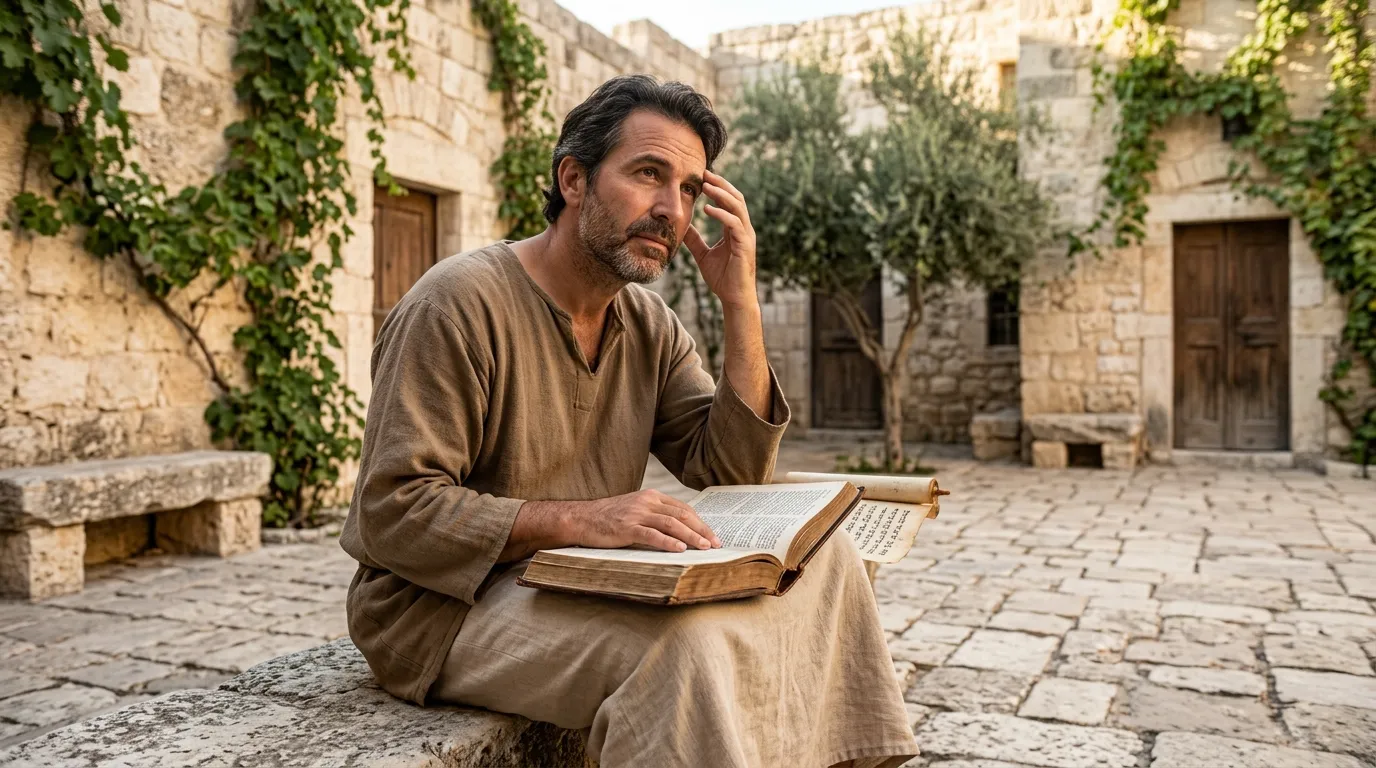
The Hebrew word is qodesh, and its root idea is not what most people expect. It does not primarily mean “morally perfect” or “religiously intense.” It means set apart — cut away from common use and dedicated to a special purpose. A holy thing in the Bible is a thing that belongs to God in a way other things do not. Holy ground, holy vessels, holy days, a holy nation: all of them are ordinary things made extraordinary by one fact — they have been claimed.
That single insight unlocks the whole doctrine. When the Bible calls God holy, it is saying He is set apart from everything else by the sheer fact of being God — utterly unique, unmixed, unapproachable in His majesty. And when the Bible calls you to be holy, it is not demanding flawless performance. It is announcing a transfer of ownership: you have been set apart for Him. Holiness is less about what you achieve and more about whose you are.
The Threefold Cry That Shook the Temple
The Bible’s most famous statement about holiness comes from Isaiah’s vision: “Holy, holy, holy is the Lord Almighty; the whole earth is full of his glory” (Isaiah 6:3). The seraphim do not cry “holy” once but three times — and in Hebrew, repetition is intensification. This is holiness at maximum volume: not one attribute among others, but the attribute that sums up all the others.
Notice what Isaiah does not do in response. He does not applaud the theology. He collapses: “Woe to me! I am ruined! For I am a man of unclean lips” (Isaiah 6:5). Encountering perfect holiness does not make a person feel spiritual; it makes them feel exposed. This is the consistent biblical pattern — Moses at the burning bush told to remove his sandals (Exodus 3:5), the disciples terrified at the Transfiguration (Matthew 17:6), John falling “as though dead” before the risen Christ (Revelation 1:17). Holiness, truly seen, always produces humility first. Any “holiness” that makes a person proud has not actually encountered the holy God.
And notice what God does next for Isaiah: a burning coal touches his lips — “your guilt is taken away and your sin atoned for” (Isaiah 6:7). The holy God does not merely expose uncleanness; He cleanses it. Holiness is not God’s way of keeping people away. It is what makes His drawing near possible.
Set Apart: What Qodesh Meant in Daily Israelite Life
To feel the word’s force, watch how Israel used it. The Sabbath was holy — set apart from the other six days (Exodus 20:8-11). The firstfruits were holy — set apart from the rest of the harvest (Leviticus 23:10). Certain vessels in the tabernacle were holy — a bowl used for the grain offering could not be casually repurposed for soup. The priests’ garments were holy. The tithe was holy.
In every case, holiness meant dedicated use. A holy object was not necessarily more beautiful or more valuable than a common one; it was simply reserved. This is why the New Testament can call ordinary believers “saints” — hagioi, holy ones — without irony. The Corinthians, riddled with division and immorality, are still addressed as “those sanctified in Christ Jesus and called to be his holy people” (1 Corinthians 1:2). Their holiness was not their achievement; it was their calling. God had set them apart, and now their lives needed to catch up with their identity.
This reframes the entire pursuit. You do not become holy to get God’s attention; you pursue holiness because you have it. “Be holy, because I am holy” (1 Peter 1:16, quoting Leviticus) is not a threat but a family resemblance: children take after their Father.
Holiness Is Not Perfectionism
Here a crucial distinction must be drawn, because confusing the two has damaged many sincere believers. Perfectionism is about performance; holiness is about belonging. Perfectionism says: never fail, never feel, never rest until you are flawless. It produces anxiety, hiding, and judgment of others. Holiness says: you belong to God, so live like it — and when you fail, return to Him, because the relationship was never based on your record.
Scripture itself proves the difference. David — adulterer, murderer, repentant psalmist — is called “a man after God’s own heart” (Acts 13:22). Peter denied Christ three times and preached at Pentecost fifty days later. The Bible’s heroes are not the flawless but the returned: people who sinned, repented, and kept walking. “The righteous fall seven times, and rise again” (Proverbs 24:16, NKJV) — note that the verse calls them righteous and describes them falling. Righteousness, biblically, includes the getting-up.
Perfectionism also misunderstands what God is after. He is not collecting flawless performances; He is forming a people — “a chosen people, a royal priesthood, a holy nation, God’s special possession, that you may declare the praises of him who called you out of darkness into his wonderful light” (1 Peter 2:9). The purpose clause matters: holiness exists that you may declare his praises. Set-apart lives are billboards for God’s character, not trophies for human effort.
What a Holy Life Actually Looks Like
If holiness is being set apart for God, what does it look like on an ordinary Wednesday? Scripture gives concrete, unglamorous answers — and they have remarkably little to do with religious intensity.
Holiness looks like honesty when lying would be easier: “Do not steal. Do not lie. Do not deceive one another” (Leviticus 19:11) — given in the same chapter as “Be holy because I, the Lord your God, am holy” (Leviticus 19:2). Ethics is holiness, not its poor cousin.
Holiness looks like sexual integrity in a culture that treats bodies as commodities: “It is God’s will that you should be sanctified: that you should avoid sexual immorality” (1 Thessalonians 4:3). The body of the believer is “a temple of the Holy Spirit” (1 Corinthians 6:19) — holy space, not common ground.
Holiness looks like mercy toward the people others discard: “Be merciful, just as your Father is merciful” (Luke 6:36). The holy God of Isaiah 6 is the same God who “defends the cause of the fatherless and the widow” (Deuteronomy 10:18). You cannot be like Him while ignoring them.
Holiness looks like Sabbath rest in a world of frantic productivity — trusting God enough to stop. And it looks like speech seasoned with grace (Colossians 4:6), money held loosely (1 Timothy 6:17-19), and forgiveness extended seventy-seven times (Matthew 18:22). None of this is spectacular. All of it is sacred.
The Holiness of the Ordinary: Work, Rest, and Table
One of the most liberating truths about biblical holiness is its range. It covers the spectacular — Isaiah’s temple vision — and the spectacularly ordinary. Paul instructs, “whether you eat or drink or whatever you do, do it all for the glory of God” (1 Corinthians 10:31). Eating and drinking. Whatever you do. The set-apart life is not confined to sanctuaries and prayer closets; it follows you to the kitchen, the office, the school run.
This means your Monday morning spreadsheet can be holy, your diaper changes can be holy, your honest business dealings can be holy — not because these tasks are religious, but because you are, and you carry the dedication with you. The priests of the old covenant were holy only inside the tabernacle courts. The priesthood of all believers (1 Peter 2:9) takes holiness everywhere. There is no secular square inch in the life of a saint.
The Holy One Who Makes Us Holy
The deepest comfort of this doctrine is that holiness is ultimately God’s work, not ours. “May God himself, the God of peace, sanctify you through and through” (1 Thessalonians 5:23) — God himself does the sanctifying. “He who began a good work in you will carry it on to completion until the day of Christ Jesus” (Philippians 1:6). We work out our salvation precisely because God is working in us (Philippians 2:12-13).
And the means of our holiness is a Person: “Christ Jesus… has become for us wisdom from God — that is, our righteousness, holiness and redemption” (1 Corinthians 1:30). Jesus does not merely teach holiness or model it. He is ours. The believer’s holiness is first a position — “you were washed, you were sanctified” (1 Corinthians 6:11), past tense, accomplished — and then a practice, the slow aligning of life with identity.
So the call “be holy” is not the demand of a distant perfectionist. It is the invitation of the Holy One who has already set you apart, already washed you, and already begun the work He promises to finish. Your part is surrender and obedience, day by day. His part is everything else — which is to say, nearly everything.
Holiness, in the end, is not about becoming less human. It is about becoming truly human — the way humanity was meant to be before the fall, and the way it will be when Christ returns: set apart, whole, radiant, home. For those who want to see how this concept has been understood across Christian traditions and centuries, the Wikipedia article on holiness traces its wider history; but the call itself comes from a voice far older than any encyclopedia: “Be holy, because I am holy” — and the grace to answer it comes from the Holy One Himself.










