In the days of Nehemiah, the scribe Ezra stood on a wooden platform before a great crowd, opened the Book of the Law, and read it aloud from morning until midday. And the Levites did something just as important as the reading: they “gave the sense, so that the people understood the reading” (Nehemiah 8:8). That verse is the entire philosophy of Bible translation in a single sentence. God’s Word must be both faithfully rendered and clearly understood. Every English Bible you have ever held exists because translators took that double calling seriously, and the Christian Standard Bible is one of the newest and most deliberate attempts to get both halves right.
So what is the CSB Bible, and what does it mean for the ordinary believer? CSB stands for Christian Standard Bible. It is a modern English translation of Scripture, first published in its complete form in 2017, revised from the earlier Holman Christian Standard Bible of 2004. It was produced by an international team of more than one hundred scholars from dozens of denominations, all affirming the full authority and inerrancy of Scripture. Its stated goal is simple to say and hard to achieve: to be as faithful to the original languages as possible while remaining as readable as possible for today’s English speakers.
Why So Many Translations Exist
New Christians sometimes wonder why there is not just one Bible in English. The answer begins with the fact that the Bible was not written in English. The Old Testament was written mostly in Hebrew with portions in Aramaic; the New Testament was written in Koine Greek, the common language of the ancient Mediterranean world. Every English Bible is a translation, an act of carrying meaning across the bridge from one language and culture to another.
Languages change. The King James Version of 1611 was a masterpiece of its era, and its phrases still echo through English literature, but four centuries of linguistic drift mean that modern readers stumble over words like concupiscence and besom that were once ordinary. New manuscript discoveries also matter. Scholars today have access to older and more numerous Hebrew and Greek manuscripts than the translators of 1611 did. And translation philosophy itself has matured, with serious debate about how best to balance accuracy and clarity.
None of this threatens the authority of Scripture. The church has always believed that God’s Word remains God’s Word when faithfully translated, just as the apostles themselves quoted the Greek Septuagint translation of the Hebrew Scriptures as authoritative. Translation is not a modern compromise. It is an ancient practice, beginning in Scripture itself.
The Philosophy: Optimal Equivalence
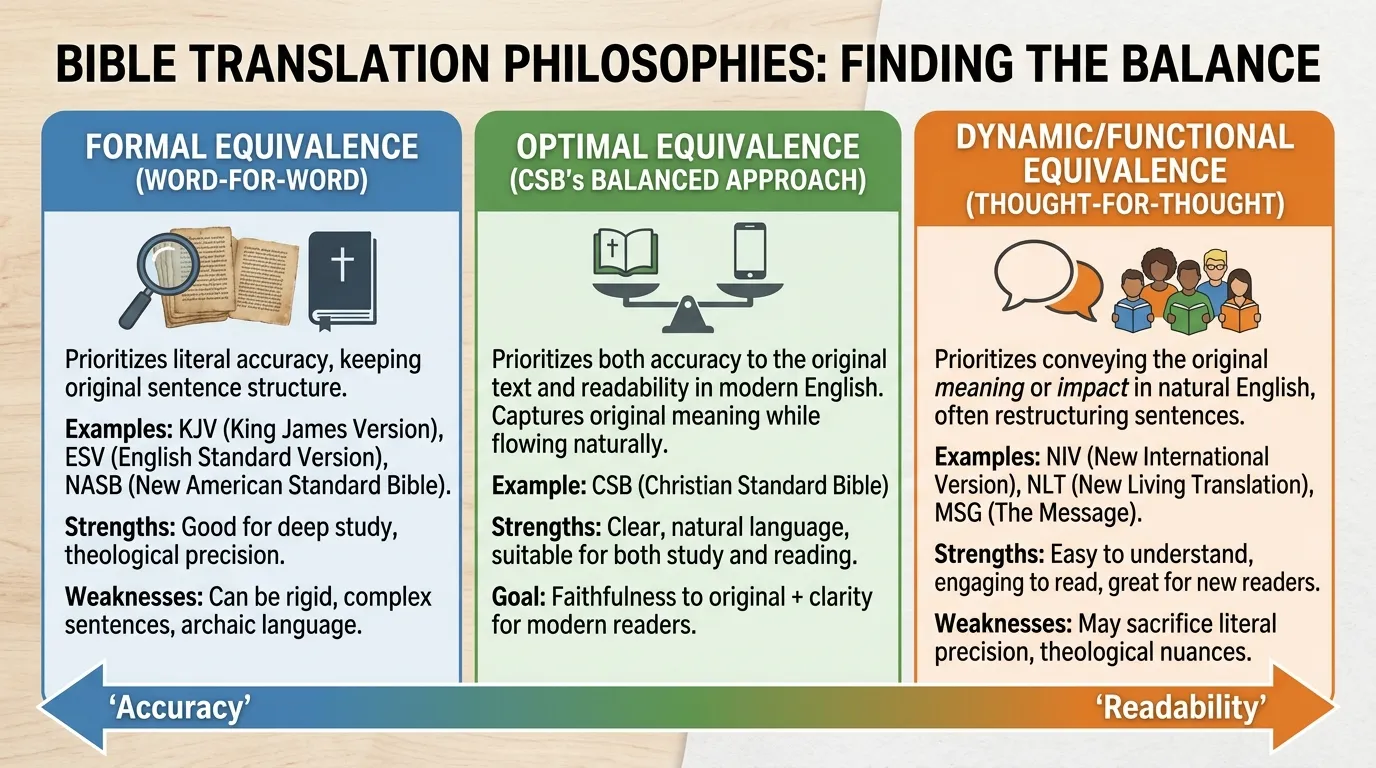
Here is where the CSB distinguishes itself. Bible translations generally fall on a spectrum. On one end is formal equivalence, sometimes called word-for-word translation, which follows the structure of the original languages as closely as possible. The ESV and NASB lean this way. On the other end is functional or dynamic equivalence, thought-for-thought translation, which prioritizes conveying the meaning in natural modern language. The NIV and NLT lean this way, with the NLT furthest toward readability.
The CSB stakes out a middle position it calls optimal equivalence: essentially literal where possible, and dynamic where necessary for clarity. In practice, this means the CSB tends to follow the original sentence structures and word choices closely, but it will not force English into unnatural shapes just to mirror Greek or Hebrew word order. Where the original uses an idiom that would confuse modern readers, the CSB renders the meaning clearly, sometimes with a footnote preserving the literal rendering.
A few examples show the approach. Where older translations say “bowels of mercy,” the CSB speaks of compassion, because modern readers do not locate emotions in the bowels. It consistently translates the Greek doulos as “servant” or “slave” depending on context, with notes explaining the range of meaning. It renders the divine name in the Old Testament as “LORD” in small caps, following the long-standing English tradition for the covenant name YHWH, while using “Yahweh” in places where the name itself is the point of the passage. These are the small, careful decisions of translators who respect both the text and the reader.
A Short History of the CSB
The CSB did not appear from nowhere. Its predecessor, the Holman Christian Standard Bible, was published in full in 2004 by Holman Bible Publishers, the publishing arm of the Southern Baptist Convention’s Lifeway. It was a fresh translation from the original languages, not a revision of an older English version, and it gained a devoted following for its readability and its study editions.
In 2017, after years of additional scholarly review, the translation was significantly revised and relaunched as the Christian Standard Bible. The revision refined thousands of renderings, updated gender language to reflect the original texts more precisely, meaning masculine terms kept where the original is specifically masculine and inclusive terms used where the original is genuinely generic, and improved consistency across the canon. The CSB is now published by Holman and widely available in print and digital formats, including respected study Bibles that many pastors and teachers use daily.
The translation team worked under a clear doctrinal commitment: the Bible is the inspired, inerrant Word of God. Every translator affirmed this. That matters because translation always involves interpretation at the margins, and knowing the translators’ convictions helps readers trust their judgment calls.
Who the CSB Serves Best
No translation is best for every purpose, and honest translators admit this. The CSB aims to be a versatile, all-purpose translation, and it largely succeeds. Its balance of accuracy and readability makes it well suited for several uses.
For personal reading and devotion, the CSB flows naturally. Long narrative passages, the stories of Genesis, the Gospels, Acts, read smoothly without the reader tripping over archaic constructions. For preaching and teaching, its essentially literal character means pastors can preach from the English text with confidence that it tracks the original closely. For memorization, its cadences are clean and modern, though those raised on the KJV or ESV may find familiar verses sounding slightly different. For study, the CSB’s extensive footnotes, which flag textual variants and alternative renderings, give serious students windows into the translators’ decisions.
It is worth saying plainly: the CSB is a conservative, evangelical translation, and readers from other traditions sometimes prefer translations produced by broader ecumenical teams, such as the NRSV. That is a fair consideration, not a flaw. Every translation reflects its translators, and wise readers know who is holding the pen.
How to Choose a Translation Without Anxiety
Christians new to serious Bible reading sometimes feel paralyzed by the options, as if choosing the wrong translation might mean missing God’s voice. Scripture itself relieves this anxiety. Paul told Timothy to be a worker who correctly handles “the word of truth” (2 Timothy 2:15), and the emphasis falls on handling, studying, applying, not on owning the single perfect English rendering. The Bereans were commended for examining the Scriptures daily, not for owning a particular edition (Acts 17:11).
A healthy approach is to choose one primary translation for deep familiarity, the CSB is an excellent candidate, and to consult others when a passage is difficult. Comparing renderings is not disloyalty to your Bible. It is good study. Many believers keep a more literal translation alongside a more dynamic one, letting each sharpen the other. What matters most is not which faithful translation you read but that you read it, understand it, and obey it. “Blessed are those who hear the word of God and keep it” (Luke 11:28). The blessing is on the keeping.
Reading the CSB Well: Practical Wisdom for Any Translation
Owning a faithful translation is only the beginning. The CSB, like every good Bible, rewards certain reading habits and exposes others. First, read whole books, not just verses. The Bible was written as letters, histories, and poems, not as collections of slogans. Reading Philippians in one sitting, as its first hearers did, transforms scattered verses into a coherent argument. The CSB’s natural English flow makes this easier than more wooden translations.
Second, use the footnotes. The CSB’s textual notes, marked with small letters, show where manuscripts differ or where the Hebrew or Greek could be rendered another way. These notes are not threats to your confidence. They are windows into the translators’ workshop, and they teach humility: here is what is certain, and here is where scholars weigh options. Third, compare translations on difficult passages. When a verse puzzles you, reading it in two or three faithful translations often clarifies what one rendering obscures. The CSB’s essentially literal approach pairs well with a more dynamic translation for this purpose.
Finally, read with obedience in view. James warns against being a hearer of the word who forgets what he heard, like a man who looks in a mirror and walks away (James 1:23-24). The goal of translation, from Ezra’s platform to the CSB’s printing press, was never information alone. It was understanding that leads to doing. Ask of every passage: what does this show me about God, and what does it ask of me? Then do it.
The CSB exists for the same reason Ezra’s platform existed: so that ordinary people can hear God’s Word and understand it. In that sense, its meaning is not found in its preface but in its purpose, to put the Scriptures into the hands and hearts of readers in language they can grasp, translated by scholars they can trust. Those curious about the broader landscape of English Bible translation history will find the Wikipedia survey of English Bible translations a useful companion, but the real test of any translation is simpler: open it, read it, and let the Word dwell in you richly.










