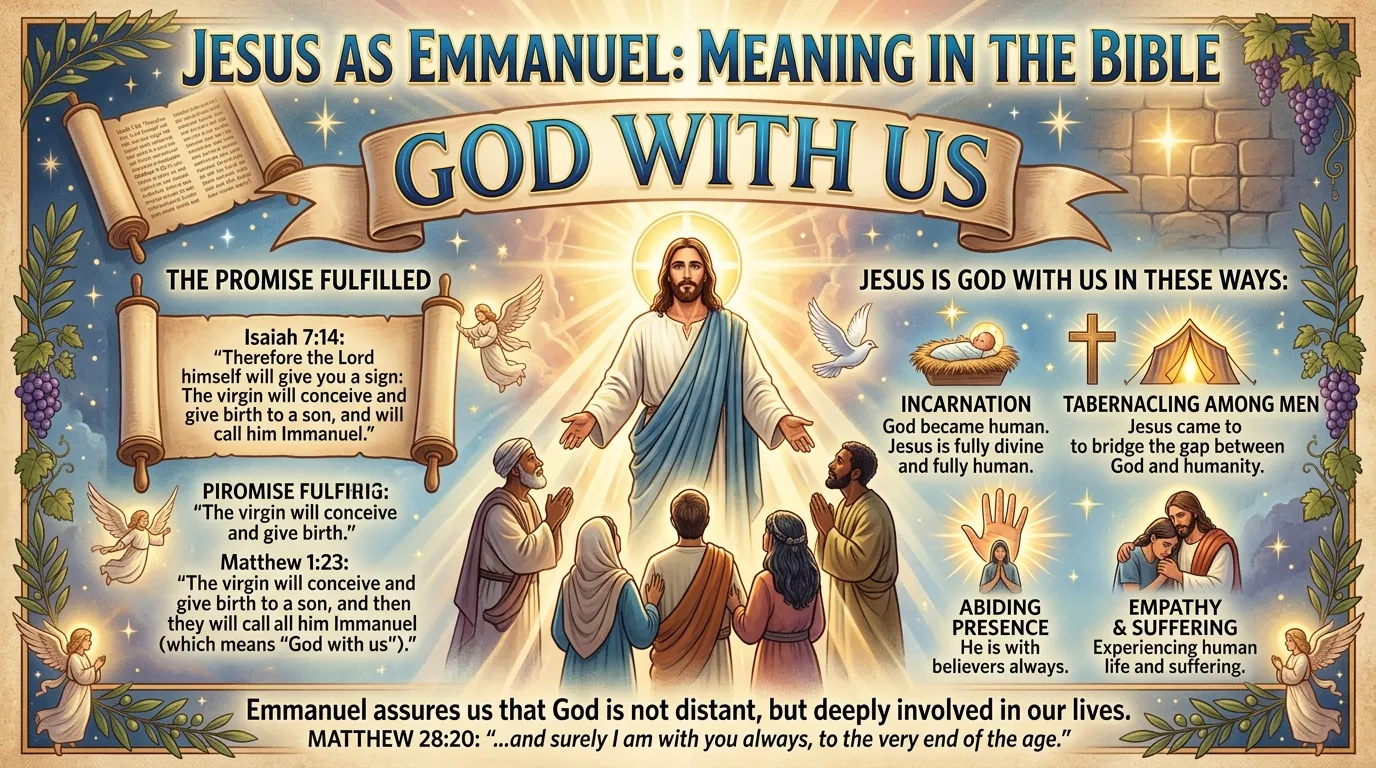
Before Jesus was called Savior, Lord, or Christ, He was called Immanuel. The name appears in Isaiah’s prophecy — “The virgin will conceive and give birth to a son, and will call him Immanuel” (Isaiah 7:14) — and Matthew applies it directly to Jesus: “All this took place to fulfill what the Lord had said through the prophet… ‘they will call him Immanuel’ (which means ‘God with us’)” (Matthew 1:22–23). Of all the names given to Jesus, Immanuel is the most intimate. It does not describe what Jesus does. It describes where God is. God is with us.
This article explores Jesus as Emmanuel — the prophecy, the fulfillment, the theology, and the daily reality of a God who is present. The name is not a Christmas decoration. It is the center of the Christian faith.
The Prophecy: A Sign in a Crisis
Isaiah’s prophecy was given in a moment of political terror. King Ahaz of Judah was facing an alliance of Syria and Israel, and he was tempted to seek help from Assyria rather than trust God. Isaiah offered Ahaz a sign — any sign, “whether in the deepest depths or in the highest heights” — and Ahaz refused, cloaking his unbelief in piety. So God gave a sign anyway: a virgin would conceive and bear a son, and before the boy was old enough to choose right from wrong, the threatening kings would be gone.
The prophecy had a near fulfillment in Isaiah’s own day, likely in the birth of a child whose early years marked the timeline of deliverance. But the prophecy also pointed beyond itself. The sign God gave was not merely a timetable. It was a promise: God would be with His people in a way He had never been before. The Hebrew name Immanu-El breaks into three parts: immanu (with us), el (God). The name is a sentence. God with us.
The Fulfillment: God With Us in Flesh
Matthew quotes Isaiah 7:14 at the very beginning of his Gospel, in the account of Joseph’s dream. Mary was found to be pregnant through the Holy Spirit. Joseph planned to divorce her quietly. An angel told him not to be afraid, because the child was from the Holy Spirit, and the child would save His people from their sins. Then Matthew adds the commentary: this was the fulfillment of Isaiah’s prophecy. The child’s name would be Jesus — “the LORD saves” — and His title would be Immanuel — “God with us.”
John’s Gospel says the same thing in different words: “The Word became flesh and made his dwelling among us” (John 1:14). The Greek word for “made his dwelling” is eskēnōsen — He tabernacled among us. The tabernacle was the tent where God dwelt with Israel in the wilderness. The temple was the house where God dwelt with Israel in Jerusalem. Jesus is the living tabernacle, the walking temple, the God who pitches His tent in our neighborhood. The presence that once filled a tent and then a temple now fills a person.
Immanuel in the Life of Jesus
The name Immanuel is not confined to the birth narratives. It describes the whole ministry of Jesus. God with us — in the manger, where He was born among animals and welcomed by shepherds. God with us — at the wedding in Cana, where He turned water into wine. God with us — at the table with tax collectors and sinners, where He ate with the excluded. God with us — in the storm, where He slept in the boat and then calmed the waves. God with us — at the grave of Lazarus, where He wept. God with us — on the cross, where He cried, “My God, my God, why have you forsaken me?” In that cry, the God who is with us experienced the horror of being forsaken, so that we would never have to be.
The presence of Jesus was not abstract. It was physical, social, and emotional. He touched lepers. He held children. He ate with outcasts. He wept with mourners. Immanuel means God does not merely observe our suffering from a distance. He enters it.
Immanuel After the Ascension
Jesus’s final words in Matthew’s Gospel are the fulfillment of the Immanuel promise: “And surely I am with you always, to the very end of the age” (Matthew 28:20). The Gospel that begins with “God with us” ends with “I am with you always.” The ascension did not end the presence. It universalized it. The Jesus who was with twelve disciples in Galilee is now with every disciple everywhere, through the Holy Spirit.
The Spirit is the presence of Immanuel continued. Jesus told His disciples, “I will ask the Father, and he will give you another advocate to help you and be with you forever — the Spirit of truth” (John 14:16–17). The Spirit dwells in believers, teaches them, comforts them, and empowers them. The church is the body of Immanuel, the community where God’s presence is experienced through the Word, the sacraments, and the love of brothers and sisters.
What Immanuel Means When God Feels Absent
Every believer knows moments when God feels absent. The psalmist cried, “My God, my God, why have you forsaken me?” Job sat in ashes and heard silence. Elijah heard no voice in the wind, the earthquake, or the fire. The doctrine of Immanuel does not deny those feelings. It anchors truth beneath them. God’s presence is not measured by our feelings. It is measured by His promise. “Never will I leave you; never will I forsake you” (Hebrews 13:5). The promise stands when the feelings fail.
Immanuel also reframes suffering. The presence of God does not always remove the trial. The three young men in the furnace were not kept out of the fire; a fourth figure appeared with them in it (Daniel 3:25). Paul was not delivered from the thorn; grace was given in it. The promise is not that God will keep us from the furnace, but that He will be with us in it. That is the difference between a God who rescues from a distance and a God who is with us.
Living as People of the Presence
To believe in Immanuel is to live as a person who is never alone. It changes prayer — prayer is not shouting into the void but speaking to the One who is present. It changes worship — worship is not a performance for an absent judge but a meeting with a present Father. It changes mission — the Great Commission is given with the promise of presence, and the presence is what makes the mission possible. It changes suffering — the darkest valley is walked with a Shepherd. And it changes hope — the end of the story is not a distant heaven but God dwelling with His people, wiping every tear, and being with them forever (Revelation 21:3).
Jesus is Emmanuel. God with us — in the manger, on the cross, in the Spirit, at the table, in the valley, and at the end of the age. The name is the gospel in three words.
Emmanuel in Isaiah’s Wider Prophecy
The Immanuel prophecy in Isaiah 7 does not stand alone. Isaiah’s book is saturated with the theme of God’s presence. In Isaiah 8, the prophet warns that if the people reject God’s presence, the Assyrian flood will sweep through, and even then “God is with us” remains the cry of judgment and hope. In Isaiah 41, God says to Israel, “Do not fear, for I am with you; do not be dismayed, for I am your God.” In Isaiah 43, He says, “When you pass through the waters, I will be with you.” The promise of presence runs through the whole book like a thread.
The Immanuel theme reaches its climax in Isaiah’s Servant Songs, where the Servant is presented as God’s presence in suffering — despised, rejected, pierced, and crushed, yet vindicated. The God who is with us is not only with us in triumph. He is with us in rejection, in pain, and in death. The manger and the cross are two ends of the same promise: God with us in birth, God with us in death, God with us forever.
Matthew’s use of Isaiah 7:14 is therefore not a proof-text ripped from context. It is the culmination of Isaiah’s whole theology of presence. The God who promised to be with Israel in exile, in flood, and in fire is now with us in flesh. The prophecy was always pointing to a person. The person is Jesus.
Emmanuel in the Old Testament Presence
Before Jesus, God’s presence was mediated through the tabernacle, the temple, the pillar of cloud and fire, and the prophets. Each was real, but each was partial. The tabernacle was a tent. The temple was a building. The cloud moved. The prophets spoke and died. Immanuel is the fullness of what those shadows pointed to: God present not in a place but in a person, not visiting but dwelling, not mediated but immediate. The Old Testament presence was a promise. Jesus is the presence itself.
For the linguistic and theological background of this name, the Wikipedia article on Immanuel provides a concise overview.










