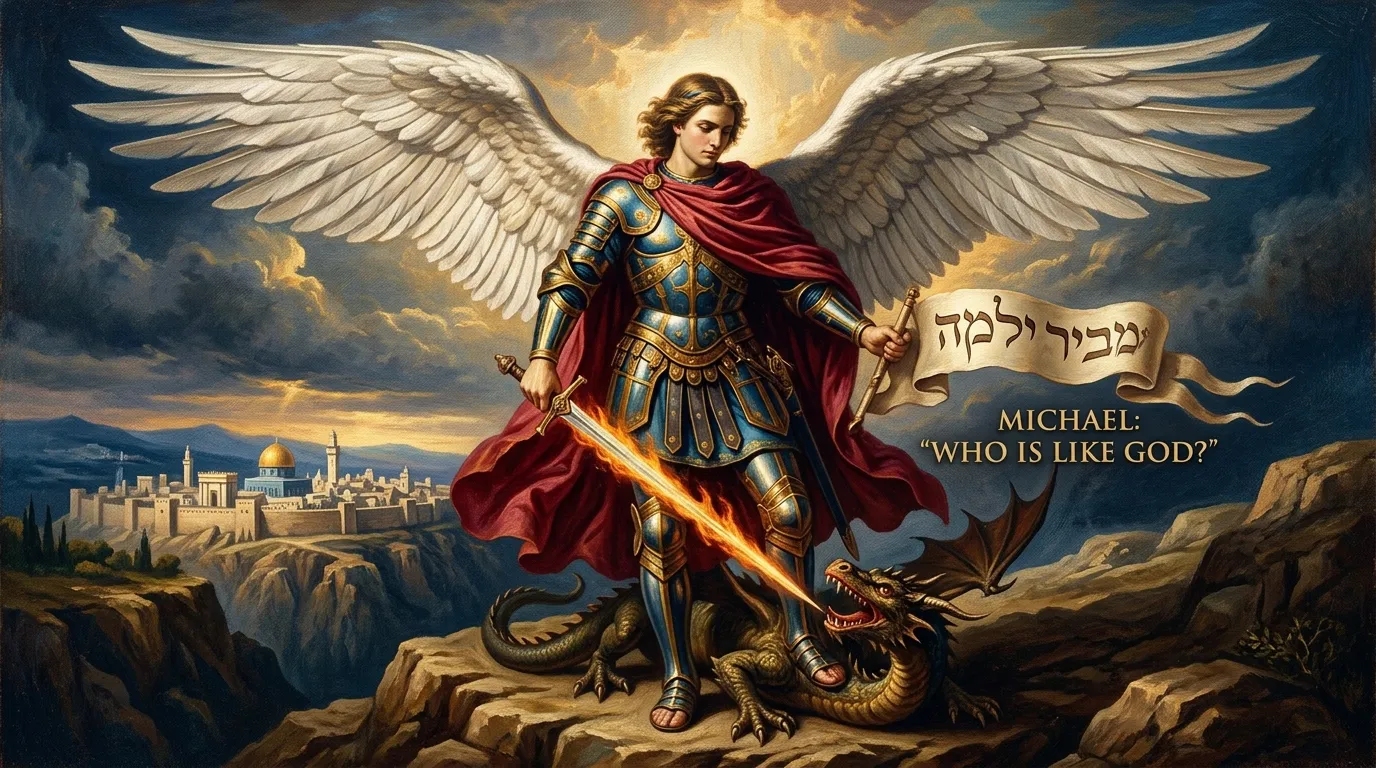
Imagine a war room where the battle is real but invisible. No satellites, no drones — only the certainty, pressed into the spirit like a handprint, that forces of darkness are maneuvering and that heaven has not left the field. The Bible pulls back the curtain on that war room exactly three times around one figure, and every time the message is the same: God fights for His people, and He has captains. The most named of those captains is Michael — and his story is far stranger, and far more humbling, than the posters suggest.
A Question for a Name
Start with the name itself, because in Scripture names are never decorative. Michael comes from the Hebrew Mi-ka-el: mi (“who”), ka (“like”), el (“God”). “Who is like God?” It is phrased as a question, but it functions as a war cry — a rhetorical thunderclap with only one possible answer: no one. Every time the name is spoken, it preaches a sermon. No rival throne, no demonic prince, no empire, no idol comes close.
This matters because Michael is not presented as a free agent or a rival power center. He is introduced in Daniel as “one of the chief princes” (Daniel 10:13) and “your prince” — Israel’s assigned guardian in the heavenly order. His entire identity is derivative: he is great because the God he serves is incomparable, and his name will not let anyone forget it. In a spiritual world full of beings that demanded worship, Michael’s name is a permanent refusal of it. Who is like God? Not me. Never me. Him.
The Angel Who Would Not Take Credit
The most revealing Michael passage is also the shortest. Jude 1:9: “But even the archangel Michael, when he was disputing with the devil about the body of Moses, did not himself dare to condemn him for slander but said, ‘The Lord rebuke you!'”
Read that again slowly, because it overturns every Hollywood angel. Here is an archangel — a being of staggering rank — in direct confrontation with Satan himself, over something as solemn as the body of Moses. And Michael refuses to bring his own authority to the fight. He does not curse the devil. He does not duel him with insults. He appeals to a higher court: The Lord rebuke you.
Jude’s point is devastating and practical. He is contrasting Michael with false teachers who “slander celestial beings” — who talk big about spiritual powers they do not understand. Michael, who actually outranks them all, models restraint. True spiritual authority never needs to prove itself with bluster. It borrows everything from God and claims nothing for itself. If you want to know whether someone’s “spiritual warfare” is biblical, Jude gives you the test: does it sound like Michael — “The Lord rebuke you” — or does it sound like someone auditioning for a throne?
There is a second lesson tucked inside: even Moses’ burial was contested ground. The devil wanted something — perhaps an idol, perhaps a relic-cult, perhaps just desecration — and heaven said no. The takeaway is quietly comforting: God guards His servants even in death. Nothing about you, not even your grave, is outside His jurisdiction.
War in Heaven
Then comes the passage everyone knows: “Then war broke out in heaven. Michael and his angels fought against the dragon, and the dragon and his angels fought back. But he was not strong enough, and they lost their place in heaven. The great dragon was hurled down — that ancient serpent called the devil, or Satan, who leads the whole world astray” (Revelation 12:7-9).
A few things to notice, because this text is routinely misread. First, Michael leads God’s angels — he is the field commander, not the king. The victory belongs to the Lamb; Revelation is explicit elsewhere that Satan is overcome “by the blood of the Lamb and by the word of their testimony” (Revelation 12:11). Michael is the instrument, not the source. Second, the outcome was never in doubt: “he was not strong enough.” This is not a cosmic coin flip. It is a mop-up operation described in military language so that persecuted believers — Revelation’s original audience, facing Rome — would know that the empire’s spiritual backers had already lost.
Third, notice when this war matters: it is revealed to encourage saints who are losing on earth. “They triumphed… they did not love their lives so much as to shrink from death” (Revelation 12:11). Michael’s war is heaven’s way of telling martyrs: what looks like defeat down here is victory up there. The dragon is already hurled down. He is dangerous, yes — a cornered dragon — but he is defeated, and Michael’s sword is the proof.
The Guardian Over God’s People
Daniel gives us Michael’s oldest assignment. In Daniel 10, a heavenly messenger — delayed three weeks by “the prince of the Persian kingdom,” a glimpse of territorial spiritual opposition — tells Daniel that Michael, “one of the chief princes, came to help me.” Then the promise sharpens in Daniel 12:1: “At that time Michael, the great prince who protects your people, will arise. There will be a time of distress such as has not happened from the beginning of nations until then. But at that time your people — everyone whose name is found written in the book — will be delivered.”
This is Michael’s job description: the great prince who protects your people. Not humanity in general — Israel, specifically, in Daniel’s context — standing watch precisely when distress peaks. The New Testament extends the comfort to all of God’s people: if heaven assigns princes to nations, how much more does the Good Shepherd watch His flock? “Are not all angels ministering spirits sent to serve those who will inherit salvation?” (Hebrews 1:14). Michael is the named proof of an unnamed army.
But note the boundary: Michael protects; he does not replace God. Daniel’s hope was never “Michael will save us” but “everyone whose name is found written in the book will be delivered.” The guardian points to the Book. The prince points to the King.
What Michael Refuses to Teach Us
Here we must be blunt, because error loves angels. Michael’s story has been inflated across the centuries into things Scripture never says: that he is Jesus (a confusion sometimes drawn from 1 Thessalonians 4:16, where the Lord descends “with the voice of the archangel” — a description of accompaniment, not identity), that he should be invoked in prayer, that he grants personal protection on demand.
Scripture draws a hard line. When John falls at an angel’s feet in Revelation, the angel rebukes him: “Don’t do that! I am a fellow servant with you… Worship God!” (Revelation 19:10). Paul warns against the “worship of angels” as a disqualifying delusion (Colossians 2:18). Michael himself models the correct posture: “The Lord rebuke you” — authority deferred upward, glory refused, worship redirected. Any teaching that makes Michael the object of devotion has missed the entire point of his name. Who is like God? The answer is the worship; Michael is the signpost.
Pray to God. Thank God for Michael and the unseen guard. Never confuse the two.
Courage Borrowed From Heaven
So what does Michael mean for a believer on an ordinary Tuesday — no dragons visible, just a hard diagnosis, a hostile workplace, a child wandering? Three things.
You are not fighting alone, and you never were. Elisha’s servant saw it when his eyes were opened: “those who are with us are more than those who are with them” (2 Kings 6:16). Michael is the biblical guarantee that the arithmetic of heaven favors God’s people.
Authority works best when it is borrowed. Michael’s “The Lord rebuke you” is the template for every believer’s confrontation with evil — not personal bravado, not formulas, but calm appeal to the Name above all names. “Resist the devil, and he will flee from you” (James 4:7) — note the order: submit to God first, then resist.
Victory is certain; faithfulness is the assignment. Michael already won his war. Yours is the smaller, harder battle: to “not love your life so much as to shrink from death” — to stay faithful in the distress before the deliverance. The great prince stands watch. The book is written. The dragon is doomed. Stand.
One more comfort, for the nights when the war room feels empty: Daniel waited three weeks for his answer while Michael fought through opposition in the unseen realm (Daniel 10:12-13). Delayed prayer is not denied prayer. Somewhere beyond your sight, the great prince may be clearing the road your answer travels. Keep praying. Heaven is not idle.
Michael’s name asks the only question that matters — who is like God? — and his life supplies the only faithful answer: no one, and therefore everything else, including every fear you carried into this article, is smaller than it looks. For the historical and traditional background of how this figure has been understood across centuries, see the entry on Michael the archangel; then return to Daniel, Jude, and Revelation, where the archangel himself keeps pointing past his own glory to the incomparable God whose question he carries as a name.










