The hotel elevator panel skips from 12 to 14. The airline has no row 13. A friend refuses to get married on the thirteenth, and half the office goes quiet when Friday the thirteenth appears on the calendar. Few numbers carry as much cultural baggage as thirteen, and many Christians wonder whether the Bible shares the suspicion. Does Scripture treat thirteen as unlucky, ominous, or evil? The answer is more interesting, and more reassuring, than superstition allows.
First, the direct answer: the Bible never calls thirteen unlucky. There is no verse that says “thirteen is an evil number” or “beware the thirteenth.” The fear of thirteen, called triskaidekaphobia, is a cultural phenomenon, not a biblical doctrine. Its roots lie in Norse mythology, medieval folklore, and the tradition that thirteen guests attended the Last Supper, with Judas as the thirteenth. But Scripture itself treats thirteen the way it treats every number: as a quantity that gains meaning only from its context, never as a vessel of supernatural luck, good or bad.
Thirteen in the Biblical Record
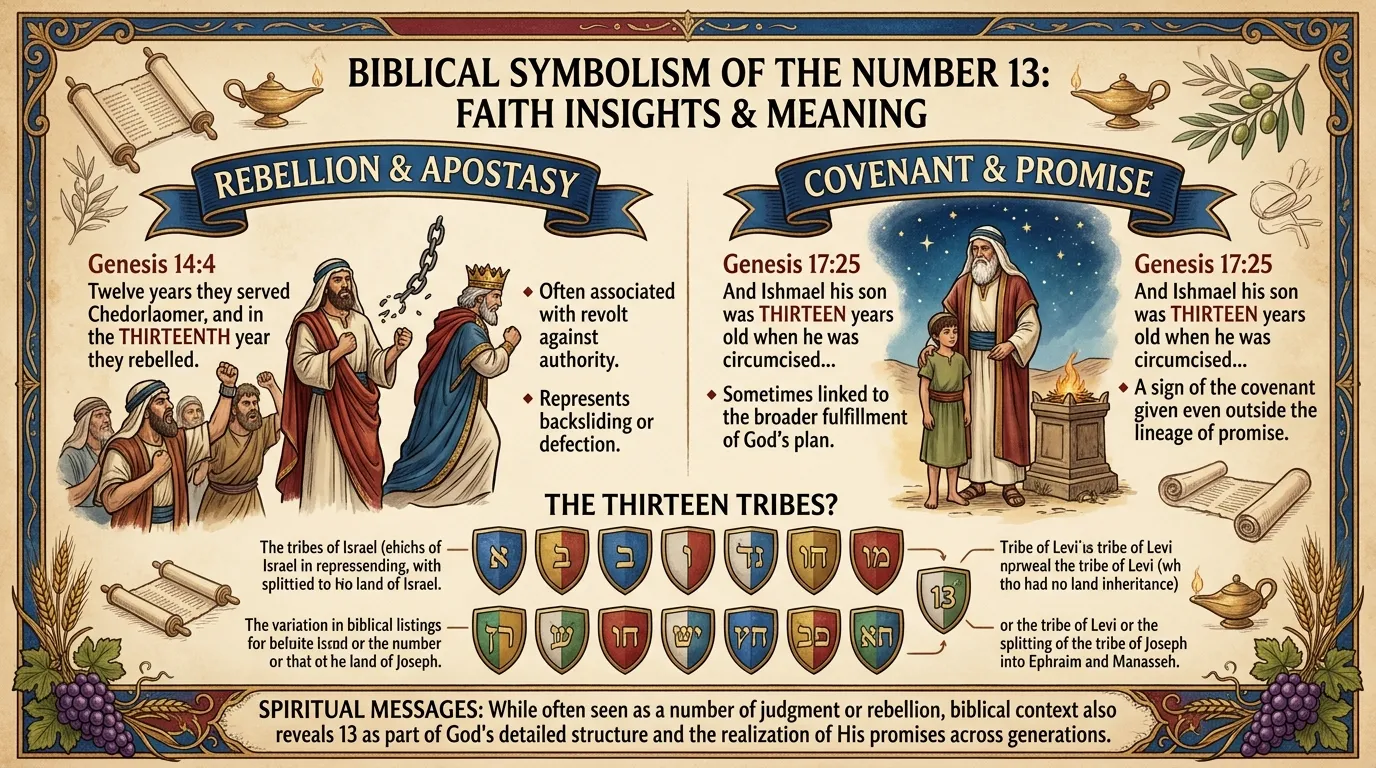
So what does the Bible actually do with thirteen? It uses it the way it uses other numbers: to count real things. Ishmael was thirteen years old when he was circumcised (Genesis 17:25). Solomon spent thirteen years building his palace (1 Kings 7:1). The tribe of Levi’s cities numbered in ways that involve thirteen in some reckonings. None of these passages attach any ominous significance to the number. It is simply how many years, how old, how much.
Some interpreters have tried to build a case for thirteen as the number of rebellion, and the arguments deserve an honest hearing. Genesis 14 records that the kings of the east served Chedorlaomer for twelve years, and “in the thirteenth year they rebelled” (Genesis 14:4). The thirteenth year was the year of rebellion. Nimrod, the archetypal rebel against God, is the thirteenth generation from Adam in some reckonings. The dragon of Revelation 12-13 and the beast rising from the sea in Revelation 13 have led some to associate thirteen with lawlessness.
These observations are intriguing, but they require caution. Building doctrine on number patterns is a fragile enterprise. The Bible nowhere authorizes numerology as a method, and the same creative counting that finds rebellion in thirteen can find almost anything in almost any number. Responsible interpretation notes the patterns without building theology on them. Thirteen may appear in contexts of testing or rebellion, but Scripture never says it means rebellion the way seven means completeness or three means divine fullness.
What the Bible Does Say About Numbers
Scripture uses numbers symbolically, but always with restraint and always anchored in clear patterns. Seven signifies completeness: seven days of creation, seven seals, seven churches. Twelve signifies God’s people: twelve tribes, twelve apostles. Three signifies divine completeness: the Trinity, the third-day resurrection. Forty signifies testing: forty years in the wilderness, forty days of fasting. These meanings emerge from repeated, unmistakable usage across the canon.
Thirteen has no such established symbolic meaning. It appears, it counts, it passes. The Bible’s silence is itself instructive. If God wanted His people to fear thirteen, He would have said so. Instead, Scripture consistently redirects fear away from numbers, omens, and luck toward the only proper object of awe: “The fear of the Lord is the beginning of wisdom” (Proverbs 9:10). Superstition, even Christian-flavored superstition, is a rival to trust. It suggests the universe runs on hidden codes rather than on the providence of a personal God.
Isaiah confronted this directly when God’s people dabbled in omens: “Should not a people inquire of their God?” (Isaiah 8:19). The issue was not curiosity about the future. It was seeking guidance from sources other than God. A Christian who plans their life around avoiding thirteen has, functionally, added a second god: luck. Scripture will not bless that trade.
The Real Thirteen: Grace Beyond Superstition
Here is a more biblical way to think about thirteen. Consider the apostles. Jesus chose twelve, and one of them, Judas, betrayed Him. After the resurrection, the eleven chose Matthias to restore the twelve (Acts 1:26). But then God chose a thirteenth apostle Himself: Paul, the former persecutor, the least likely candidate, who called himself “the least of the apostles” and “one untimely born” (1 Corinthians 15:8-9). If thirteen must mean something, let it mean this: God’s grace reaches the unlikely, the extra, the one nobody counted.
Or consider that Jesus plus the twelve made thirteen at the Last Supper, the meal where Christ instituted the New Covenant. The thirteenth guest at that table was not a curse but the Savior. The number thirteen sat at the table where grace was served. Superstition sees thirteen chairs and fears the last one. Faith sees thirteen chairs and remembers who sat in the middle.
When Numbers Become Idols
The deeper biblical principle is about where we place our confidence. “Some trust in chariots and some in horses, but we trust in the name of the Lord our God” (Psalm 20:7). Update the verse for modern superstition: some trust in lucky numbers and some in avoiding unlucky ones, but we trust in the name of the Lord. A believer who will not fly on the thirteenth has not discovered a spiritual secret. They have surrendered a piece of their peace to a number.
Jesus dismantled this kind of thinking when He taught about God’s meticulous care: “Are not two sparrows sold for a penny? And not one of them will fall to the ground apart from your Father. But even the hairs of your head are all numbered” (Matthew 10:29-30). If God numbers the hairs on your head, no number on a calendar or an elevator panel operates outside His sovereignty. Thirteen cannot harm you. Seven cannot save you. Only God governs outcomes, and He governs them in love.
Paul adds the theological capstone: “We know that for those who love God all things work together for good” (Romans 8:28). All things. Including the thirteenth of the month. Including Friday the thirteenth. Including the hotel room on the thirteenth floor that the elevator pretends does not exist. God’s providence does not take days off for superstition.
Freedom From Fear: The Christian Response
So what should a Christian do when thirteen keeps appearing, on clocks, receipts, addresses, or in dreams? First, do not panic. The appearance of a number is not a message from the universe. Second, do not build theology on coincidence. The human brain is wired to find patterns, and faith is not improved by feeding that wiring with superstition. Third, use the moment as a prompt for trust. Every time the world says “be afraid of thirteen,” the believer can answer, “my times are in God’s hand” (Psalm 31:15).
And if thirteen appears in a season of rebellion or testing in your life, let Scripture interpret the season, not the number. The Bible’s answer to rebellion is repentance (Acts 3:19). Its answer to testing is endurance (James 1:12). Its answer to fear is perfect love casting out fear (1 John 4:18). Numbers do not diagnose souls. The Word does.
When the Number Follows You: A Pastoral Word
Some readers will finish the theology and still feel uneasy, because thirteen keeps showing up: on the clock at 1:13, on receipts, in addresses, in dreams. The feeling is real even when the fear is unfounded, so here is practical counsel. First, do not treat repetition as revelation. The human mind is a pattern-finding machine. Once thirteen is on your radar, you will notice it everywhere, the same way you notice a car model everywhere after buying one. Psychologists call this the frequency illusion. It is not a sign.
Second, replace the ritual with truth. If you catch yourself avoiding something because of thirteen, pause and speak Scripture to yourself instead: “My times are in your hand” (Psalm 31:15). Deliberately doing the ordinary thing, taking the thirteenth-floor meeting, signing on the thirteenth, can be a small act of faith, a way of telling your heart who is actually in charge. Third, examine what the anxiety reveals. Number fear is often a symptom of a deeper sense that life is fragile and out of control. That feeling is accurate. The solution is not a luckier number but a surer God: “God is our refuge and strength, a very present help in trouble” (Psalm 46:1).
And if thirteen appears during a genuinely hard season, let the season, not the number, drive you to God. Pray honestly. Seek counsel. Repent where needed. Trust where required. The number is scenery. God is the story.
Thirteen is a number, nothing more and nothing less. It counts years and guests and building projects. It does not curse, and it does not bless. The God who made all numbers, and who numbers our days, is the only power worth fearing and the only refuge worth trusting. For more on the cultural history of triskaidekaphobia and how the fear of thirteen developed outside Scripture, the Wikipedia article on triskaidekaphobia traces its fascinating history, but the Bible’s verdict is simpler and stronger: fear God, not numbers.










