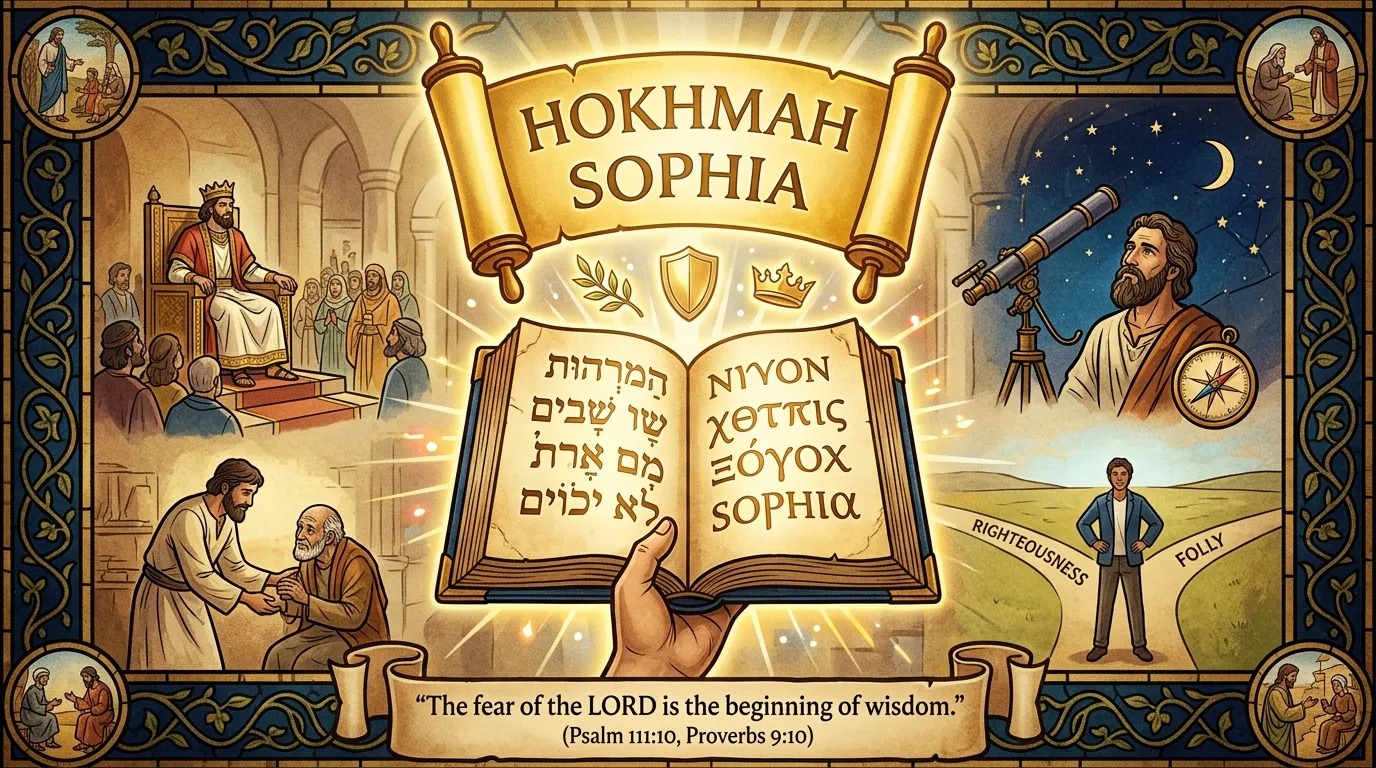
The young king could not sleep. Solomon had just inherited the throne of Israel from his father David, and the weight of it pressed on him like a stone. That night at Gibeon, God appeared to him in a dream and made an astonishing offer: “Ask what I shall give you” (1 Kings 3:5). A blank check from the Almighty. Solomon could have asked for long life, for wealth, for the death of his enemies, the usual royal wish list. Instead he asked for something stranger: “Give your servant therefore an understanding mind to govern your people, that I may discern between good and evil” (1 Kings 3:9). God was so pleased that He gave Solomon wisdom and the things he did not ask for. That ancient night captures the Bible’s entire teaching on wisdom: it is the one thing worth asking for, and it changes everything else.
The Hebrew word at the heart of biblical wisdom is chokmah, and it means far more than intelligence. Chokmah is skill, the same word used for the craftsmanship of Bezalel building the tabernacle (Exodus 31:3). Wisdom in the Bible is skill in living, the craft of navigating a complicated world according to God’s design. It is not measured by IQ but by the quality of one’s choices. A brilliant fool is still a fool, and Scripture says so repeatedly.
The Foundation: Fear of the Lord
Every biblical discussion of wisdom begins in the same place: “The fear of the Lord is the beginning of wisdom” (Proverbs 9:10). This is not terror. It is reverent awe, the recognition that God is God and we are not, that His ways are higher and His judgments true. Wisdom begins when a person stops treating themselves as the ultimate authority and submits to the One who actually is.
This foundation explains why the world’s wisest people can be fools by biblical standards. A genius who denies God has skipped the first chapter. “The fool says in his heart, ‘There is no God'” (Psalm 14:1). Meanwhile, an uneducated believer who trusts and obeys God possesses the beginning of true wisdom. The starting line is not intellect. It is reverence. Everything else is built on that, or it is built on sand.
Proverbs hammers this home through contrast. The wise person listens, learns, and turns from evil. The fool despises instruction, repeats folly, and rushes toward destruction. The book is brutally practical because wisdom is brutally practical. It shows up in how you handle money, choose friends, speak to your spouse, raise children, and respond to criticism. Wisdom that stays theoretical is not wisdom yet.
Wisdom Personified: The Woman Calling in the Streets
One of Proverbs’ most striking moves is personifying wisdom as a woman crying out in public places: “Wisdom cries aloud in the street, in the markets she raises her voice” (Proverbs 1:20). She is not hidden in a temple or locked in a library. She shouts at the city gates, at the crossroads, wherever people make decisions. The image insists that wisdom is accessible. God is not hiding the instruction manual.
Proverbs 8 gives Lady Wisdom her great speech. She was present at creation, “beside him, like a master workman” (Proverbs 8:30), delighting in the world God made. This means wisdom is woven into the fabric of reality. Living wisely is not arbitrary rule-following. It is aligning with how the universe actually works, the way a sailor aligns with the wind rather than fighting it. “Blessed is the one who listens to me… for whoever finds me finds life” (Proverbs 8:34-35).
Opposite her stands the foil: Folly, also personified as a woman, also calling out, offering stolen water and secret bread (Proverbs 9:13-18). Every day, every person stands at the crossroads between two voices. Wisdom’s path leads to life. Folly’s path, for all its excitement, leads to the grave. The choice is daily, and it is never neutral.
Wisdom in Action: What It Looks Like
James provides the New Testament’s clearest portrait of wisdom embodied. “Who is wise and understanding among you? By his good conduct let him show his works in the meekness of wisdom” (James 3:13). True wisdom is meek, not arrogant. It shows in conduct, not credentials. Then James contrasts two wisdoms: earthly wisdom, marked by bitter jealousy and selfish ambition, which is “earthly, unspiritual, demonic” (James 3:15), and wisdom from above, which is “first pure, then peaceable, gentle, open to reason, full of mercy and good fruits, impartial and sincere” (James 3:17).
That list is a diagnostic tool. Facing a decision? Ask which option reflects purity, peace, gentleness, reasonableness, mercy. The wise choice rarely looks like the clever choice. Cleverness wins arguments. Wisdom wins the long game. Cleverness asks, “How can I get what I want?” Wisdom asks, “What does God want, and what will this cost in ten years?”
Jesus embodied this wisdom perfectly. The Gospels marvel at His teaching: “Where did this man get this wisdom?” (Matthew 13:54). He answered traps with questions, silenced accusers with a sentence, and told stories that still reorder lives two millennia later. Paul identifies Him as “the wisdom of God” (1 Corinthians 1:24). To know Christ is to know wisdom incarnate, and to follow Him is the wisest possible life strategy.
How to Get Wisdom: Ask
Perhaps the most encouraging verse on wisdom is also the simplest: “If any of you lacks wisdom, let him ask God, who gives generously to all without reproach, and it will be given him” (James 1:5). God does not ration wisdom. He gives it generously, without shaming the asker. The only condition is faith: ask believing, not doubting. Solomon asked in a dream and woke up wise. James promises the same God still answers.
But asking is not the only discipline. Scripture is wisdom’s textbook: “The law of the Lord is perfect, reviving the soul… making wise the simple” (Psalm 19:7). Counsel is wisdom’s safeguard: “Where there is no guidance, a people falls, but in an abundance of counselors there is safety” (Proverbs 11:14). Experience, reflected on honestly, is wisdom’s teacher. And obedience is wisdom’s proof: “Everyone then who hears these words of mine and does them will be like a wise man who built his house on the rock” (Matthew 7:24). Hearing without doing is the definition of folly.
There is also a wisdom in knowing what you do not know. “Do not be wise in your own eyes” (Proverbs 3:7). Agur’s prayer in Proverbs 30 is the Bible’s most honest confession of intellectual humility: “I am too stupid to be a man. I have not the understanding of a man” (Proverbs 30:2-3). True wisdom includes the wisdom to admit ignorance, ask for help, and change course when wrong.
The End of Wisdom: A Life Well Built
Wisdom’s promise is not a trouble-free life. The wise still suffer; Job is proof. Its promise is a life well built, a house on rock that stands when storms come (Matthew 7:24-25). “Wisdom is better than jewels, and all that you may desire cannot compare with her” (Proverbs 8:11). Length of days, riches, honor, pleasant ways, peace, these are wisdom’s companions, not always in the ways we expect, but truly.
Solomon’s story ends with a sobering footnote: the wisest man who ever lived eventually stopped listening to wisdom and followed his foreign wives into idolatry (1 Kings 11). Wisdom possessed is not wisdom retained. It must be practiced daily, or it leaks away like water from a cracked vessel. The beginning of wisdom is the fear of the Lord. The continuation of wisdom is the same fear, renewed every morning.
Wisdom About Wealth: Solomon’s Later Warning
Irony shadows Solomon’s story. The man who chose wisdom over wealth eventually accumulated staggering riches, seven hundred wives, and a divided heart. His later writings read like a man auditing his own life. “Vanity of vanities! All is vanity” (Ecclesiastes 1:2). The wisest man alive discovered that wisdom misapplied, or wisdom abandoned, cannot save even the wise.
Ecclesiastes is wisdom literature’s honest memoir. Solomon tried pleasure, projects, possessions, and philosophy, and found them all “striving after wind” without God at the center. His conclusion is the Bible’s conclusion: “Fear God and keep his commandments, for this is the whole duty of man” (Ecclesiastes 12:13). Wisdom that does not end in reverence and obedience is not wisdom. It is cleverness with a longer resume.
The warning for today is direct. You can possess biblical knowledge, make shrewd decisions, and build an impressive life, yet drift from the fear of the Lord that made it all meaningful. Wisdom must be maintained, not merely acquired. Solomon’s life is both an inspiration, ask and receive, and a caution, receive and remain. The beginning of wisdom is the fear of the Lord. The end of wisdom, for those who finish well, is the same fear, deepened by a lifetime of proving it true.
Ask, as Solomon asked. Listen, as Proverbs pleads. Build, as Jesus taught. For those who want to explore how the concept of wisdom has been pondered across philosophical traditions as well, the Wikipedia article on wisdom offers a broad survey, but the Bible’s offer stands alone in its simplicity: ask God, and He will give generously.










